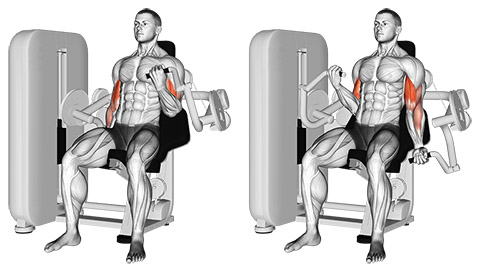
To do a Machine Bicep Curl, adjust the seat so your elbows line up with the pivot, set the pad on your upper arms, and curl with your shoulders down. It trains the biceps most, with the forearms assisting. The most common mistake is setting the seat too low or too high, which shifts stress into the shoulders, so adjust the seat and try one easy rep before you load up. Progress by adding reps first, then move the pin one plate when all sets stay smooth.
Step-by-step form
- Set up: Adjust the seat so elbows align with the machine pivot.
- Brace: Place upper arms on the pad and grip the handles evenly.
- Initiate: Squeeze glutes and keep shoulders down.
- Main rep path: Curl the handles up without lifting your elbows.
- Hardest point: Pause briefly near the top and keep wrists straight.
- Finish: Lower under control to full elbow extension.
- Reset: Re-breathe and repeat with the same seat position.
Who this variation is for
Machine curls are ideal when you want extra stability and an easy way to load the biceps without balancing free weights.
- Best fit: Beginners learning a strict curl pattern
- Not ideal when: The machine does not fit your arm length comfortably
- Better option if not ideal: Cable Bicep Curl
Setup and equipment
Spend an extra minute on the seat and pad height. It pays off.
- Setup position: Elbows level with the machine pivot, upper arms supported
- Equipment setup checks: Seat locked, pin fully inserted, handles symmetric
- Start load/resistance: Light enough to keep shoulders down and still
- Bracing and breathing plan: Inhale before the curl, exhale as you lower
Muscles worked and movement pattern
This is elbow flexion with high stability. The biceps should do most of the work with little torso movement.
| Role | Muscles |
|---|---|
| Primary | Biceps |
| Secondary | Brachialis, forearms |
| Stabilizers | Core, upper back |
How to check your form
- Elbows line up with the pivot.
- Upper arms stay on the pad.
- Shoulders stay down and back.
- Smooth 2-3 second lowering.
- Stop if the pad lifts off your arms.
Beginner mistakes and quick fixes
| Mistake | Why It Happens | Fix |
|---|---|---|
| Seat too low or too high | Rushing setup | Adjust seat so elbows match the pivot |
| Shoulders hiking up | Load is too heavy | Reduce load and keep shoulders down |
| Pad lifting off upper arms | Range is too large or you are sliding | Sit back and keep hips and chest anchored |
What you should feel
- At the start of each rep: Upper arms anchored on the pad
- During lowering or lengthening: Biceps stretching with steady tension
- During the hardest point: Biceps working hardest, not shoulders
- At lockout or finish: Full extension without shoulder roll
- If you feel joint pain: Reduce load and shorten range slightly
Regressions (Easier Versions)
- Lighter pin weight with a shorter range to learn control
- Cable curl with a lighter load if the machine feels awkward
Progressions (Harder Versions)
- 1-second pause near the top each rep
- Slower 3-second lowering with the same load
Alternatives by Equipment
| Alternative | When to use it | Why it helps |
|---|---|---|
| Cable | When you want a similar stable setup | Easy to keep tension consistent |
| Dumbbell | When you want more wrist freedom | Lets each arm find its best path |
| Barbell | When you want heavier loading | Simple to add small weight jumps |
How many sets and reps for beginners
Pick the track that fits your goal. Keep 1-3 reps in reserve and focus on clean mechanics.
For Strength
- Sets: 3-4
- Reps: 5-8
- Rest: 2-3 min
- Frequency: 1-2x/week
- Progression rule: Add one pin once all sets hit the top reps cleanly
For Muscle Growth
- Sets: 3-5
- Reps: 8-15
- Rest: 60-120 sec
- Frequency: 2-3x/week
- Progression rule: Add reps first, then increase the pin one notch
For Skill / Return to Training
- Sets: 2-3
- Reps: 10-12
- Rest: 60-90 sec
- Frequency: 2x/week
- Progression rule: Smooth tempo and elbow position before load
4-week example progression
| Week | Sets x reps | Load or difficulty target | Goal |
|---|---|---|---|
| 1 | 3 x 10 | Light pin weight | Learn seat and pad setup |
| 2 | 3 x 11-12 | Same load | Keep shoulders down |
| 3 | 3 x 8-10 | +1 pin | Maintain full range |
| 4 | 4 x 8-10 | Same load as week 3 | Consistent tempo |
Where to put this in your workout
- Primary slot: After your main pulling exercise
- Best pairing: Pair with triceps pressdowns
- Fatigue note: Stop if shoulders start to rise
Safety and Contraindications
Use a range that keeps your shoulders quiet and your elbows comfortable. If the machine does not fit your arm length, choose another variation.
- Stop the set if: Sharp elbow or shoulder pain appears
- Use caution if: You have a recent biceps tendon flare-up
- Safer substitutions: Cable curl, dumbbell curl, EZ-bar curl
FAQs
Do I need to lock the seat height every session?
Yes, use the same seat notch every time. It keeps the elbow aligned with the pivot and makes progression more consistent.
Should I use a full range on the machine?
Use the range you can control without the pad lifting or shoulders shrugging. Full range is great if it stays smooth.
Is the machine easier than dumbbells?
It is usually more stable, which makes it feel easier to control. That stability can be helpful when learning form or adding volume.
Can I do this with one arm at a time?
If the machine allows it, yes. One-arm curls can help you fix left-right differences.
Related Exercises
Related Workouts
- No related workouts yet.