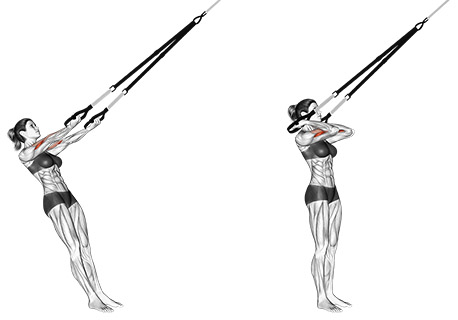
To do a Suspension Bicep Curl, set the straps to mid-length, lean back with a straight body line, and curl by bending only at the elbows. It trains the biceps most, with the forearms assisting. The most common mistake is letting the hips sag or elbows flare, so tighten your glutes and keep elbows pointed down. Keep the straps even so each arm carries the same load and the handles stay level. Progress by walking your feet forward to increase the body angle once you can complete every set with steady control.
Step-by-step form
- Set up: Adjust straps to mid-length and grab handles.
- Brace: Walk feet forward and lean back in a straight line.
- Initiate: Squeeze glutes and keep ribs down.
- Main rep path: Bend elbows to bring hands toward your forehead.
- Hardest point: Pause with elbows still pointing down.
- Finish: Straighten arms slowly to the start position.
- Reset: Re-breathe and keep the same body angle.
Who this variation is for
Suspension curls are a good fit when you want a bodyweight option that is easy to scale by changing your body angle.
- Best fit: Beginners who want a simple bodyweight curl
- Not ideal when: Shoulder discomfort shows up in the leaned-back position
- Better option if not ideal: Cable Bicep Curl
Setup and equipment
Lock the straps and pick a body angle you can control.
- Setup position: Straps even length, body in a straight line
- Equipment setup checks: Anchor secure, handles level, straps not twisted
- Start load/resistance: Start more upright so you can keep hips level
- Bracing and breathing plan: Inhale at the start, exhale as you straighten arms
Muscles worked and movement pattern
This is elbow flexion with bodyweight resistance. You should feel steady biceps tension while the core keeps the body line straight.
| Role | Muscles |
|---|---|
| Primary | Biceps |
| Secondary | Brachialis, forearms |
| Stabilizers | Core, glutes, upper back |
How to check your form
- Body stays in one straight line.
- Elbows stay pointed down.
- Hips do not sag.
- Slow, steady lowering.
- Change angle instead of swinging.
Beginner mistakes and quick fixes
| Mistake | Why It Happens | Fix |
|---|---|---|
| Hips sagging | Core and glutes are relaxed | Squeeze glutes and tighten abs |
| Elbows flaring wide | Hands drift away from the head | Keep elbows in and point them down |
| Straps uneven | Setup rushed | Reset strap length and square the handles |
What you should feel
- At the start of each rep: Full-body tension with a stable body line
- During lowering or lengthening: Biceps stretching while core stays tight
- During the hardest point: Biceps working hardest, not shoulders
- At lockout or finish: Arms straight and body still
- If you feel joint pain: Step your feet back to reduce the angle
Regressions (Easier Versions)
- More upright body angle to reduce load
- Seated cable curl if suspension setup is uncomfortable
Progressions (Harder Versions)
- Walk feet forward to increase body angle
- 1-second pause at the top of each rep
Alternatives by Equipment
| Alternative | When to use it | Why it helps |
|---|---|---|
| Cable | When you want constant tension | Easy to control load |
| Dumbbell | When you want free wrist movement | Allows natural wrist path |
| Barbell | When you want heavier loading | Easy to progress weight |
How many sets and reps for beginners
Choose a rep range you can control. Avoid failure while learning the body angle.
For Strength
- Sets: 3-4
- Reps: 6-10
- Rest: 2-3 min
- Frequency: 1-2x/week
- Progression rule: Increase body angle when you can hit top reps
For Muscle Growth
- Sets: 3-5
- Reps: 8-15
- Rest: 60-120 sec
- Frequency: 2-3x/week
- Progression rule: Add reps, then step feet forward for more challenge
For Skill / Return to Training
- Sets: 2-3
- Reps: 8-12
- Rest: 60-90 sec
- Frequency: 2x/week
- Progression rule: Keep hips level before increasing angle
4-week example progression
| Week | Sets x reps | Load or difficulty target | Goal |
|---|---|---|---|
| 1 | 3 x 8 | Upright angle | Learn body line control |
| 2 | 3 x 9-10 | Same angle | Smooth tempo |
| 3 | 3 x 8 | Feet slightly forward | Maintain hip level |
| 4 | 4 x 8-10 | Same angle as week 3 | Consistent reps |
Where to put this in your workout
- Primary slot: After a main pull or row
- Best pairing: Pair with a triceps press or rear-delt work
- Fatigue note: Stop if the body line breaks
Safety and Contraindications
Keep the anchor secure and the body line straight. If you feel shoulder pain, reduce the angle or pick a different curl option.
- Stop the set if: Sharp shoulder or elbow pain appears
- Use caution if: You have a recent shoulder strain
- Safer substitutions: Cable curl, dumbbell curl, EZ-bar curl
FAQs
How do I make the suspension curl harder?
Walk your feet forward to increase the body angle. Keep the hips level and the straps even as you get harder.
Should my hands move toward my forehead or chest?
Toward your forehead is typical for this variation. The key is that only the elbows bend and the body stays straight.
Can I do this one arm at a time?
Yes, but start with two arms first. Single-arm curls are harder to stabilize and require more core control.
What strap length should I use?
Mid-length is a good starting point. Shorter straps make the setup feel tighter but are not required.
Related Exercises
Related Workouts
- No related workouts yet.