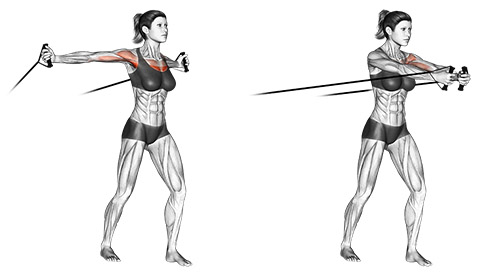
To do a resistance band chest fly, anchor the band at chest height, take a staggered stance, and sweep your hands forward in a wide arc until they meet at midline, then return under control. It trains the chest most, with front delts and core stabilizers assisting. The most common mistake is losing tension by stepping too close to the anchor; fix it by stepping forward until you feel tension before the first rep. Progress by adding reps first, then step farther out or use a thicker band.
Step-by-step form
- Set up: Anchor the band at chest height and grab both handles.
- Brace: Take a staggered stance and set ribs over hips.
- Initiate: Raise your arms to the sides with a soft elbow bend.
- Main rep path: Sweep your hands forward to meet in front of the chest.
- Hardest point: Squeeze the chest without shrugging.
- Finish: Pause briefly with hands together.
- Reset: Return until you feel a chest stretch, then repeat.
Who this variation is for
This is a flexible chest option for home or travel training when you want a smooth squeeze without heavy equipment.
- Best fit: Lifters training at home who still want a chest fly pattern
- Not ideal when: The band anchor is unstable or shoulder pain flares
- Better option if not ideal: Incline Push Ups or Dumbbell Chest Fly
Setup and equipment
A solid anchor and the right stance keep the band from pulling you out of position.
- Setup position: Staggered stance, slight forward lean, elbows softly bent
- Equipment setup checks: Anchor is secure and level; band is not twisted
- Start load/resistance: Tension present at the start position for 10-15 reps
- Bracing and breathing plan: Inhale on the way back, exhale as hands meet
Muscles worked and movement pattern
This is a horizontal adduction pattern with rising band tension. You should feel the chest more as the hands meet.
| Role | Muscles |
|---|---|
| Primary | Pectoralis major |
| Secondary | Front delts |
| Stabilizers | Serratus anterior, rotator cuff, core |
At a glance
- Variation: Resistance band chest fly
- Best for: Travel or home chest training
- Primary muscles: Chest
- Equipment: Resistance band and anchor point
- Difficulty: Beginner to intermediate
- Primary goal: Muscle growth
Form tips for better reps
- Start with band tension already on.
- Keep elbows softly bent and fixed.
- Hands meet at mid-chest height.
- Keep ribs stacked, no big arch.
- Control the return for 2-3 seconds.
Mistakes that limit your progress
| Mistake | Why It Happens | Fix |
|---|---|---|
| Band goes slack at the start | You are standing too close | Step forward until tension stays on. |
| Elbows bend into a press | Band is too heavy | Use a lighter band and keep a fixed elbow angle. |
| Shoulders shrug as you squeeze | Upper traps take over | Think "shoulders down" before each rep. |
What you should feel
- At the start of each rep: Light tension in the chest and steady core.
- During lowering or lengthening: A gradual stretch across the pecs.
- During the hardest point: Strong squeeze at midline.
- At lockout or finish: Stable shoulders with no shrugging.
- If you feel joint pain: Reduce range and step closer to the anchor.
Regressions (Easier Versions)
- Short-range band fly with a smaller step forward.
- Incline Push Ups for a lighter load.
Progressions (Harder Versions)
- Step farther forward to increase tension.
- Slow 4-second lower for more time under tension.
Alternatives by Equipment
| Alternative | When to use it | Why it helps |
|---|---|---|
| Dumbbell Chest Fly | You have a bench and dumbbells | Long stretch and easy load changes. |
| Machine Chest Fly | You want a fixed path | Stable and easy to track. |
| Cable Fly Crossovers | You have a cable station | Constant tension through the arc. |
How many sets and reps to do
Treat this like a high-quality accessory after pressing. Keep the movement smooth and stop sets when the range shortens.
For Strength
- Sets: 3-4
- Reps: 6-8
- Rest: 2-3 min
- Frequency: 1-2x/week
- Progression rule: Use a thicker band once you hit 8 clean reps
For Muscle Growth
- Sets: 3-5
- Reps: 10-15
- Rest: 60-90 sec
- Frequency: 2-3x/week
- Progression rule: Add reps, then step farther from the anchor
For Skill / Return to Training
- Sets: 2-3
- Reps: 8-12
- Rest: 60-120 sec
- Frequency: 2x/week
- Progression rule: Increase range and tempo control before resistance
4-week example progression
| Week | Sets x reps | Load or difficulty target | Goal |
|---|---|---|---|
| 1 | 3 x 12 | Light band, slow lower | Learn the arc |
| 2 | 3 x 15 | Same band, longer squeeze | Build control |
| 3 | 4 x 12 | Step farther forward | Add tension |
| 4 | 4 x 12-15 | Same step, slower lower | Solidify form |
Where to put this in your workout
- Use it after presses or between push and pull supersets.
- Pair it with a row or face pull to keep shoulders balanced.
- If time is short, use it as a finisher for 2 quick sets.
Safety and Contraindications
Bands should feel smooth and predictable. If the anchor moves or you feel shoulder pain, stop and reset.
- Stop the set if: The band slips or shoulder pain appears
- Use caution if: You have shoulder instability or limited shoulder range
- Safer substitutions: Incline Push Ups, Machine Chest Fly, Dumbbell Floor Fly
FAQs
How far should I step forward?
Far enough that the band is taut before you start. You should feel light tension with your arms open.
Can I do this without handles?
Yes, but grip comfort matters. If the band digs into your hands, use handles or a towel loop.
Why do I feel more shoulders than chest?
Your elbows may be too straight or your ribs may be flaring. Set a soft elbow bend and keep ribs down.
Is a higher or lower anchor better?
Chest height is the default. A higher anchor biases the lower chest, while a lower anchor shifts the line upward.
Related Exercises
Related Workouts
- No related workouts yet.