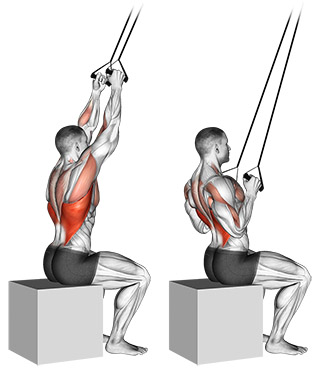
To do a Resistance Band Lat Pulldown, anchor the band overhead, kneel or sit tall, and pull the band to your upper chest while keeping your ribs stacked. It primarily trains the lats, with the upper back and biceps assisting. The most common mistake is letting the band go slack at the top, so step back or sit farther from the anchor to keep tension. Progress by adding reps first, then move to a thicker band once every set stays smooth and controlled.
Step-by-step form
- Set up: Anchor the band securely overhead.
- Brace: Kneel or sit tall and grab the band with both hands.
- Initiate: Pull shoulder blades down before bending elbows.
- Main rep path: Drive elbows down toward your ribs.
- Hardest point: Pause when hands reach upper chest height.
- Finish: Control the return to a full overhead stretch.
- Reset: Re-stack ribs and keep tension on the band.
Who this variation is for
Band pulldowns work well when you want a joint-friendly vertical pull at home or on the road. If the band snaps or slips, switch to a safer setup.
- Best fit: Intermediate lifters needing a portable lat option
- Not ideal when: You cannot keep tension through the full range
- Better option if not ideal: Cable Lat Pulldown
Setup and equipment
A secure anchor and steady tension make the band version feel smooth.
- Setup position: Band anchored overhead, torso tall, ribs stacked
- Equipment setup checks: Anchor secure, band free of tears, no slack at top
- Start load/resistance: Light band that allows 10-15 controlled reps
- Bracing and breathing plan: Inhale at the top, exhale as you pull down
Muscles worked and movement pattern
This is a vertical pull with elastic resistance. You should feel the lats and mid-back working while the torso stays tall.
| Role | Muscles |
|---|---|
| Primary | Lats |
| Secondary | Upper back, biceps |
| Stabilizers | Core, rotator cuff |
At a glance
- Variation: Resistance band
- Best for: Portable, joint-friendly lat training
- Primary muscles: Lats
- Equipment: Resistance band and secure anchor
- Difficulty: Intermediate
- Primary goal: Clean range and tension control
How to spot and fix bad form
- Band stays tight at the top.
- Shoulder blades move down first.
- Elbows drive down, not back.
- Torso stays tall, not leaning back.
- Smooth control back to the top.
Why your form breaks down and how to fix it
| Mistake | Why It Happens | Fix |
|---|---|---|
| Band goes slack at the top | You are too close to the anchor | Step back or sit farther away |
| Leaning back to finish reps | Band is too heavy | Use a lighter band and keep ribs stacked |
| Elbows flaring wide | Grip too wide | Bring hands closer together |
What you should feel
- At the start of each rep: Band tension and shoulders set down
- During lowering or lengthening: Stretch through the sides of the back
- During the hardest point: Lats and mid-back, not neck
- At lockout or finish: Arms long with tension still on the band
- If you feel joint pain: Reduce range and use a lighter band
Regressions (Easier Versions)
- Lighter band with a shorter range
- Seated band pulldown to reduce balance demands
Progressions (Harder Versions)
- Thicker band with the same range
- 1-second pause at the bottom of each rep
Alternatives by Equipment
| Alternative | When to use it | Why it helps |
|---|---|---|
| Cable pulldown | When you want consistent resistance | Easier to fine-tune load |
| Machine pulldown | When you want a fixed path | Reduces setup errors |
| Dumbbell row | When you want heavier pulling | Builds strength through a row pattern |
How to program around sticking points
Keep most sets at a smooth tempo. If tension drops, move closer or change bands.
For Strength
- Sets: 4-5
- Reps: 6-8
- Rest: 2-3 min
- Frequency: 1-2x/week
- Progression rule: Move to a thicker band once reps stay strict
For Muscle Growth
- Sets: 3-5
- Reps: 10-15
- Rest: 60-120 sec
- Frequency: 2-3x/week
- Progression rule: Add reps first, then increase band thickness
For Skill / Return to Training
- Sets: 2-4
- Reps: 10-12
- Rest: 60-90 sec
- Frequency: 2x/week
- Progression rule: Maintain tension at the top before load increases
4-week example progression
| Week | Sets x reps | Load or difficulty target | Goal |
|---|---|---|---|
| 1 | 3 x 12 | Light band | Keep tension at the top |
| 2 | 3 x 13-14 | Same band | Smooth tempo |
| 3 | 4 x 10-12 | Thicker band | Keep ribs stacked |
| 4 | 4 x 10-12 | Same band as week 3 | Full stretch control |
Troubleshooting block
If the band snaps or slips, stop and reset the anchor. If shoulders feel pinchy, use a neutral grip by holding the band narrower and reduce the overhead stretch. If the band feels too light at the bottom, slow the lowering phase and add a 1-second pause at the top.
Safety and Contraindications
Bands can slip or tear, so check the anchor and the band before every set. If you feel sharp shoulder pain, reduce range and switch to a lighter band.
- Stop the set if: Band slips, snaps, or shoulder pain appears
- Use caution if: You have a recent shoulder impingement flare-up
- Safer substitutions: Cable pulldown, machine pulldown, chest-supported row
FAQs
How high should the band be anchored?
Anchor it above your head so you can get a full stretch at the top. If the anchor is too low, you will lose range.
Should I kneel or sit?
Either works. Kneeling helps keep the torso tall, while sitting can be more stable if balance is an issue.
Why does the band feel easy at the bottom?
Bands are easiest when they are shortest. Slow the lowering phase and add a pause to increase tension.
Can I use this instead of a lat pulldown machine?
Yes, as long as you can keep steady tension and a full range. If you cannot, a cable or machine option will be more consistent.
Related Exercises
Related Workouts
- No related workouts yet.