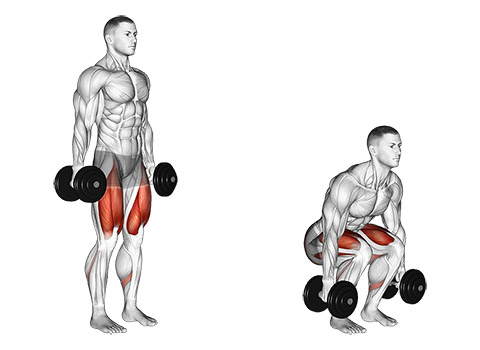
To do a dumbbell squat, hold the dumbbells at your sides, brace, sit down and back with full-foot pressure, then stand up without swinging the weights. It primarily trains the quadriceps, with heavy work from glutes and hamstrings. The most common mistake is letting the dumbbells drift forward and pull you out of position, so keep them close to your legs and slow the descent. Progress by adding reps with the same depth and tempo, then add a small load.
Step-by-step form
- Set up: Stand tall with dumbbells at your sides and feet shoulder width.
- Brace: Inhale and tighten your core while keeping shoulders stacked over hips.
- Initiate: Sit down and back, keeping dumbbells close to your thighs.
- Main rep path: Lower until thighs are at least parallel, if pain-free.
- Hardest point: Keep chest tall and knees tracking toes at the bottom.
- Finish: Drive through midfoot to stand without swinging the dumbbells.
- Reset: Exhale at the top and re-brace for the next rep.
Who this variation is for
Dumbbell squats are ideal for lifters who want loading progress with more freedom than a barbell and enough control to chase higher-quality reps.
- Best fit: Advanced lifters tracking load and rep quality
- Not ideal when: Grip limits your lower-body work or shoulder pain flares
- Better option if not ideal: Smith machine squat or barbell squat with straps
Setup and equipment
Keep the dumbbells close to your sides and a stance that matches your hip structure.
- Setup position: Feet shoulder width, toes slightly out, dumbbells at sides
- Equipment setup checks: Flat shoes or stable soles, clear floor space
- Start load/resistance: Choose a load you can squat for 6-10 clean reps
- Bracing and breathing plan: Big inhale before descent, exhale near the top
Muscles worked and movement pattern
This is a knee and hip dominant squat with a vertical torso and free-weight loading. You should feel steady quad and glute work without the dumbbells pulling you forward.
| Role | Muscles |
|---|---|
| Primary | Quadriceps |
| Secondary | Glutes, hamstrings |
| Stabilizers | Core, upper back, calves |
Performance snapshot
- Variation: Dumbbell
- Best for: Load progression with freedom of movement
- Primary muscles: Quadriceps, glutes
- Equipment: Dumbbells
- Difficulty: Advanced
- Primary goal: Strength and muscle
Technique cues for heavier loads
- All reps hit the same depth.
- Dumbbells stay close to the legs.
- Tempo stays steady across the set.
- No torso collapse at the bottom.
- You can pause for 1 second without losing balance.
Mistakes that limit your progress
| Mistake | Why It Happens | Fix |
|---|---|---|
| Dumbbells drift forward | Lats are loose or stance is too narrow | Pull shoulders down and widen stance slightly. |
| Depth shortens as load rises | You rush the descent | Slow the first half of the lowering phase. |
| Torso folds at the bottom | Brace fades under fatigue | Reset breath before each rep or cut the set early. |
What you should feel
- At the start of each rep: Stable foot pressure and tight core.
- During lowering or lengthening: Quads and glutes loading evenly.
- During the hardest point: Strong leg drive without the dumbbells swinging.
- At lockout or finish: Tall posture and steady balance.
- If you feel joint pain: Shorten the range and lower the load.
Regressions (Easier Versions)
- Goblet squat with a single dumbbell for easier balance.
- Box squat to limit depth while you build control.
Progressions (Harder Versions)
- Dumbbell pause squat with a 2-second hold at the bottom.
- Front-racked dumbbell squat once you can pause 10 reps with stable depth.
Alternatives by Equipment
| Alternative | When to use it | Why it helps |
|---|---|---|
| Barbell squat | You want heavier loading | Allows larger weight jumps |
| Smith machine squat | You want a fixed bar path | Reduces balance limits |
| Bodyweight squat | You are deloading | Maintains the pattern with low stress |
How to keep getting stronger
Choose a strength or hypertrophy track and track both load and depth. For performance work, keep 1-2 reps in reserve until the final set.
For Strength
- Sets: 4-6
- Reps: 4-6
- Rest: 2-3 min
- Frequency: 1-3x/week
- Progression rule: Add 2.5-5% load when all sets hit target depth.
For Muscle Growth
- Sets: 3-5
- Reps: 6-12
- Rest: 90-120 sec
- Frequency: 2-3x/week
- Progression rule: Add reps first, then load after two clean sessions.
For Skill / Return to Training
- Sets: 2-4
- Reps: 6-10
- Rest: 90 sec
- Frequency: 2x/week
- Progression rule: Increase depth and tempo control before load.
4-week example progression
| Week | Sets x reps | Load or difficulty target | Goal |
|---|---|---|---|
| 1 | 4 x 6 | Moderate load | Lock in depth and tempo |
| 2 | 4 x 7 | Same load | Build volume without form loss |
| 3 | 5 x 6 | Add 2.5-5% load | Raise strength output |
| 4 | 5 x 6-7 | Match week 3 load | Cleaner reps under fatigue |
Progress benchmarks
Use these to decide when to load up.
- 10 reps with a 2-second pause and no balance shift
- Same depth across all working sets
- No forward drift of the dumbbells in the last two reps
- You can add 2.5-5% load without losing tempo
Safety and Contraindications
Keep the dumbbells close and the torso steady. Stop the set if your knees cave or your back rounds, then adjust stance and load.
- Stop the set if: Sharp joint pain or sudden loss of balance
- Use caution if: Grip or shoulder pain limits control
- Safer substitutions: Goblet squat, Smith machine squat, or box squat
FAQs
Should I hold the dumbbells at my sides or in front?
Most lifters should start with the dumbbells at their sides. A front hold is harder on the core and only makes sense once the side hold feels stable.
How heavy should dumbbells be for squats?
Use a load that lets you hit target depth for 6-10 reps with steady tempo. If depth shortens early, lighten the load.
Why do my wrists or shoulders hurt?
Pain often comes from gripping too hard or letting the dumbbells drift forward. Keep them close and relax the shoulders between reps.
Can I use dumbbell squats for strength?
Yes, especially for moderate loads and higher reps. Once you outgrow the dumbbells, transition to a barbell or machine squat.
Related Exercises
Related Workouts
- No related workouts yet.