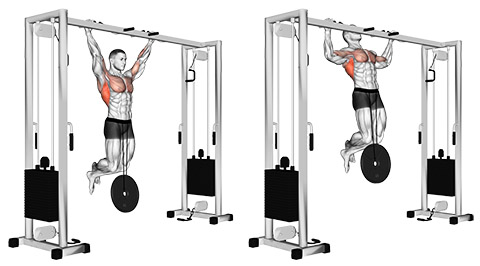
To do a plate pull up, attach a plate to a dip belt, start from a full hang, and pull your chest toward the bar with a controlled lower. It targets the lats most, with traps, rear delts, and biceps assisting. The most common mistake is adding weight before you can keep a strict tempo, so keep the same rep speed before loading more. Progress by adding reps, then add 2.5-5% load once every set stays clean.
Step-by-step form
- Set up: Attach a plate to a dip belt and step under the bar.
- Brace: Grip the bar slightly wider than shoulder width.
- Initiate: Pull shoulders down and back before bending elbows.
- Main rep path: Drive elbows toward your ribs as the chest rises.
- Hardest point: Pause with chin near bar height and shoulders down.
- Finish: Lower for 2-3 seconds to a full hang.
- Reset: Re-brace at the bottom and repeat.
Who this variation is for
This is for lifters who can already do strict bodyweight pull ups and want measurable strength progress.
- Best fit: Advanced lifters training pull-up strength and speed
- Not ideal when: Shoulder or elbow pain shows up at lighter loads
- Better option if not ideal: Bodyweight pull up or machine pull up
Setup and equipment
Your setup should feel secure and repeatable before you load heavy.
- Setup position: Dip belt tight, plate secure, torso tall
- Equipment setup checks: Carabiner locked, plate centered, bar stable
- Start load/resistance: A load you can pull for 4-6 strict reps
- Bracing and breathing plan: Inhale at the hang, exhale as you pull
Muscles worked and movement pattern
This is shoulder adduction and elbow flexion under added load. You should feel lats doing most of the work.
| Role | Muscles |
|---|---|
| Primary | Lats |
| Secondary | Traps, rear delts, biceps |
| Stabilizers | Core, forearms |
At a glance
- Variation: Plate pull up (weighted)
- Best for: Pull-up strength and power
- Primary muscles: Lats
- Equipment: Dip belt, weight plate, pull-up bar
- Difficulty: Advanced
- Primary goal: Strength
Technique cues for heavier loads
- Pull shoulders down before you bend elbows.
- Keep ribs stacked over hips, no swinging.
- Pause briefly near the top.
- Lower for 2-3 seconds every rep.
- Reset in a full hang each rep.
Mistakes that limit your progress
| Mistake | Why It Happens | Fix |
|---|---|---|
| Kipping or swinging | Load is too heavy | Reduce load and keep ribs stacked. |
| Shortening the range | Fatigue builds too fast | Use fewer reps or longer rest. |
| Shrugging at the top | Traps take over | Pull shoulders down before every rep. |
What you should feel
- At the start of each rep: Lats on stretch with a tight brace
- During lowering or lengthening: Smooth tension through lats and mid back
- During the hardest point: Strong squeeze under the armpits
- At lockout or finish: Full hang without shoulder pain
- If you feel joint pain: Reduce load and shorten range
Regressions (Easier Versions)
- Bodyweight pull up with strict tempo
- Resistance band pull up for lighter loading
Progressions (Harder Versions)
- 2-second pause at the top of each rep
- Add 2.5-5% load once speed stays consistent
Alternatives by Equipment
| Alternative | When to use it | Why it helps |
|---|---|---|
| Bodyweight pull up | When you need more volume | Keeps skill sharp with less fatigue |
| Machine pull up | When joints need less load | Controlled assistance and stable path |
| Cable lat pulldown | When the bar irritates shoulders | Similar lats focus with different angle |
How to keep getting stronger
Use a heavy day and a lighter volume day each week. Track tempo and bar speed so load increases do not hide sloppy reps.
For Strength
- Sets: 4-6
- Reps: 3-5
- Rest: 2-4 min
- Frequency: 1-2x/week
- Progression rule: Add 2.5-5% load after two weeks of clean top reps.
For Muscle Growth
- Sets: 3-4
- Reps: 6-10
- Rest: 90-150 sec
- Frequency: 2x/week
- Progression rule: Add reps first, then add a small load jump.
For Skill / Return to Training
- Sets: 2-3
- Reps: 4-8
- Rest: 90 sec
- Frequency: 1-2x/week
- Progression rule: Keep tempo strict before adding load.
4-week example progression
| Week | Sets x reps | Load or difficulty target | Goal |
|---|---|---|---|
| 1 | 4 x 4 | Baseline load | Clean reps, no swing |
| 2 | 4 x 5 | Same load | Add controlled reps |
| 3 | 5 x 3 | +2.5-5% load | Higher intensity, same tempo |
| 4 | 5 x 4 | Same load | Repeat strong reps under fatigue |
When to increase weight or difficulty
- Baseline benchmark: All sets hit target reps with a full hang each rep.
- Progress marker after 2-3 weeks: Add 2.5-5% load without speed loss.
- Advanced progression trigger: Add a 2-second top pause at the same load.
Safety and Contraindications
If elbows or shoulders get cranky, lower the load and shorten the range for a week or two.
- Stop the set if: Sharp shoulder or elbow pain appears
- Use caution if: You have recent shoulder or elbow flare-ups
- Safer substitutions: Bodyweight pull up, machine pull up
FAQs
How heavy should my first plate be?
Start with a load you can do for 3-5 strict reps without swinging. If bar speed slows early, the plate is too heavy.
Should I use a belt or hold the plate between my feet?
Use a belt when possible. It keeps the load centered and reduces swinging.
How often should I train weighted pull ups?
Most lifters do best with 1-2 focused sessions per week. Add volume only if recovery is solid.
What is a good benchmark to aim for?
A clean set of 3-5 reps with 10-20% of bodyweight is a strong early milestone for most advanced lifters.
Related Exercises
Related Workouts
- No related workouts yet.