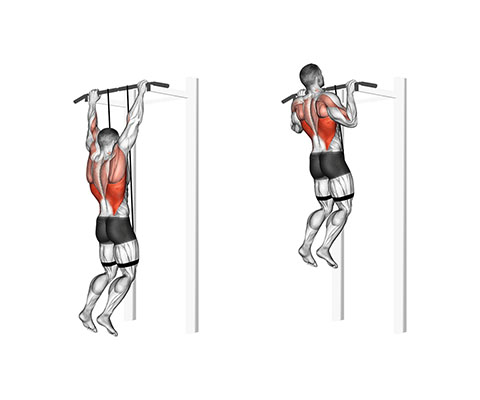
To do a resistance band pull up, loop the band securely, keep tension through the hang, and pull your chest toward the bar with a controlled lower. It targets the lats most, with traps, rear delts, and biceps assisting. The most common mistake is letting the band bounce you through reps, so choose a band you can control and slow the descent. Progress by adding reps or switching to a thinner band once your tempo stays consistent.
Step-by-step form
- Set up: Loop a band over the bar and make sure it is secure.
- Brace: Place a knee or foot in the band and grip the bar.
- Initiate: Pull shoulders down and back before bending elbows.
- Main rep path: Drive elbows toward your ribs as your chest rises.
- Hardest point: Pause with chin near bar height and shoulders down.
- Finish: Lower for 2-3 seconds to a controlled hang.
- Reset: Keep tension in the band and repeat.
Who this variation is for
This is for lifters who are building strict pull-up strength and need scalable assistance.
- Best fit: Intermediate lifters working toward bodyweight reps
- Not ideal when: Band setup causes shoulder discomfort
- Better option if not ideal: Machine pull up or neutral-grip lat pulldown
Setup and equipment
Band choice and anchor security matter more than load numbers here.
- Setup position: Band centered on the bar, knee or foot secure
- Equipment setup checks: Check for tears and re-loop if the band slides
- Start load/resistance: A band that allows 6-10 strict reps
- Bracing and breathing plan: Inhale at the hang, exhale as you pull
Muscles worked and movement pattern
This is shoulder adduction and elbow flexion with band assistance. You should feel the lats doing most of the work.
| Role | Muscles |
|---|---|
| Primary | Lats |
| Secondary | Traps, rear delts, biceps |
| Stabilizers | Core, forearms |
At a glance
- Variation: Resistance band pull up
- Best for: Building strict pull-up reps
- Primary muscles: Lats
- Equipment: Pull-up bar, looped band
- Difficulty: Intermediate
- Primary goal: Strength and control
How to spot and fix bad form
- Keep shoulders down, not shrugged.
- Use a full hang between reps.
- Lower for 2-3 seconds every rep.
- Keep elbows angled toward ribs.
- Avoid bouncing off the band.
Why your form breaks down and how to fix it
| Mistake | Why It Happens | Fix |
|---|---|---|
| Band bounces you through reps | Band is too thick | Switch to a thinner band or slow the lower. |
| Knees swing forward | Losing core tension | Tuck ribs down and keep a light hollow body. |
| Short range at the bottom | Skipping the hang | Start each rep from a controlled full stretch. |
What you should feel
- At the start of each rep: Lats on stretch with a tight brace
- During lowering or lengthening: Smooth tension through lats and mid back
- During the hardest point: Strong squeeze under the armpits
- At lockout or finish: Full hang without shoulder pain
- If you feel joint pain: Shorten range and use a thicker band
Regressions (Easier Versions)
- Thicker band with the same tempo
- Machine pull up with controlled lowering
Progressions (Harder Versions)
- Thinner band once you hit top reps cleanly
- 1-2 second pause at the top of each rep
Alternatives by Equipment
| Alternative | When to use it | Why it helps |
|---|---|---|
| Bodyweight pull up | When you can control full range | Direct carryover to strict reps |
| Machine pull up | When you want stable assistance | Easy to dial in support |
| Lat pulldown machine | When the bar irritates shoulders | Similar lats focus with a different path |
How to program around sticking points
Use band work to fix weak spots in the range. Pair slow eccentrics with lighter assistance for strength carryover.
For Strength
- Sets: 3-5
- Reps: 4-8
- Rest: 2-3 min
- Frequency: 1-2x/week
- Progression rule: Switch to a thinner band once all sets hit top reps cleanly.
For Muscle Growth
- Sets: 3-4
- Reps: 8-12
- Rest: 90-120 sec
- Frequency: 2-3x/week
- Progression rule: Add reps first, then reduce band thickness.
For Skill / Return to Training
- Sets: 2-3
- Reps: 6-10
- Rest: 90 sec
- Frequency: 2x/week
- Progression rule: Keep the lower slow before reducing assistance.
4-week example progression
| Week | Sets x reps | Load or difficulty target | Goal |
|---|---|---|---|
| 1 | 3 x 8 | Baseline band | Full hang, slow lower |
| 2 | 3 x 9 | Same band | Add controlled reps |
| 3 | 4 x 6 | Thinner band | Higher intensity, same tempo |
| 4 | 4 x 7 | Same band | Repeat clean reps under fatigue |
What to do if this exercise hurts
- Likely cause: Band pulls you into a range your shoulders do not like.
- Immediate modification: Shorten the range and use a thicker band.
- Swap option if symptoms persist: Neutral-grip lat pulldown.
Safety and Contraindications
If shoulders or elbows feel irritated, use more assistance and slow the lowering phase.
- Stop the set if: Sharp shoulder pain or numbness appears
- Use caution if: You have recent shoulder or elbow flare-ups
- Safer substitutions: Machine pull up, neutral-grip lat pulldown
FAQs
Which is better, knee or foot in the band?
Either works. A foot in the band is more stable for many lifters, but a knee is easier for taller athletes.
How do I choose the right band?
Pick the thinnest band that still lets you control 6-10 clean reps. If you bounce, it is too thick.
How often should I train band-assisted pull ups?
Most lifters do well with 2 focused sessions per week. Add volume only if recovery stays solid.
When should I move to bodyweight reps?
When you can do 8-10 clean reps with the thinnest band for two sessions in a row.
Related Exercises
Related Workouts
- No related workouts yet.