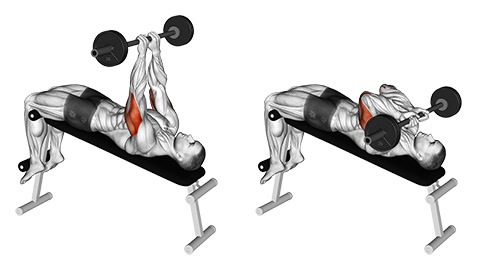
To do a barbell skullcrusher, lie on a flat bench, grip the bar just inside shoulder width, lower it toward your forehead, then extend the elbows without moving your upper arms. It targets the triceps most. The most common mistake is letting the elbows flare and turning it into a press, so keep elbows stacked over shoulders and lower with a steady tempo. Progress by adding reps or a 2-3 second lowering before increasing load.
Step-by-step form
- Set up: Lie on a flat bench with feet planted and bar over your chest.
- Brace: Squeeze glutes and keep ribs down.
- Initiate: Lock the upper arms in place, elbows pointed up.
- Main rep path: Lower the bar toward your forehead or just behind it.
- Hardest point: Pause briefly without letting elbows flare.
- Finish: Extend elbows to return the bar over your chest.
- Reset: Re-brace and repeat with the same elbow position.
Who this variation is for
This is for lifters who want direct triceps work and can keep elbow position stable through the set.
- Best fit: Intermediates building triceps strength and size
- Not ideal when: Elbow pain flares or you lose elbow control
- Better option if not ideal: Machine triceps pushdown
Setup and equipment
A small grip change can save your elbows. Start with a grip just inside shoulder width.
- Setup position: Flat bench, bar over chest, elbows pointed up
- Equipment setup checks: Bar centered, bench stable, spotter or safeties nearby
- Start load/resistance: A load you can control for 8-12 reps
- Bracing and breathing plan: Inhale before lowering, exhale as you extend
Muscles worked and movement pattern
This is elbow extension with the upper arm mostly fixed. You should feel the triceps working hard, not the shoulders.
| Role | Muscles |
|---|---|
| Primary | Triceps |
| Secondary | Forearms |
| Stabilizers | Shoulders, core |
At a glance
- Variation: Barbell skullcrusher
- Best for: Direct triceps strength and size
- Primary muscles: Triceps
- Equipment: Barbell, flat bench
- Difficulty: Intermediate
- Primary goal: Hypertrophy
How to spot and fix bad form
- Elbows stay stacked over shoulders.
- Upper arms do not drift backward.
- Lowering is slow and controlled.
- Bar stops above the forehead, not on it.
- Wrists stay neutral, not bent back.
Why your form breaks down and how to fix it
| Mistake | Why It Happens | Fix |
|---|---|---|
| Elbows flare out | Load is too heavy | Reduce load and keep elbows pointed up. |
| Bar drifts toward the face | Upper arms move | Lock upper arms and pause at the bottom. |
| Wrist pain | Bar sits too low in the palm | Keep wrists stacked and grip the bar deeper. |
What you should feel
- At the start of each rep: Triceps tension with stable shoulders
- During lowering or lengthening: Stretch through the triceps
- During the hardest point: Triceps working, elbows still
- At lockout or finish: Straight elbows without shoulder drift
- If you feel joint pain: Reduce load and shorten the range slightly
Regressions (Easier Versions)
- Machine triceps pushdown for more stability
- Rope pushdown with lighter load and smoother range
Progressions (Harder Versions)
- 2-second pause just above the forehead each rep
- 3-second lowering with the same load
Alternatives by Equipment
| Alternative | When to use it | Why it helps |
|---|---|---|
| Machine triceps pushdown | When you want more stability | Keeps elbows fixed and load steady |
| Rope pushdown machine | When elbows feel cranky | Allows wrist rotation and comfort |
| Barbell close-grip press | When you want heavier triceps loading | Uses more total load |
How to program around sticking points
Keep volume moderate and focus on elbow position. One sloppy set can irritate elbows quickly.
For Strength
- Sets: 3-5
- Reps: 5-8
- Rest: 2-3 min
- Frequency: 1-2x/week
- Progression rule: Add 1 rep per set before increasing load.
For Muscle Growth
- Sets: 3-4
- Reps: 8-12
- Rest: 90-120 sec
- Frequency: 2-3x/week
- Progression rule: Add reps to the top of the range, then add load.
For Skill / Return to Training
- Sets: 2-3
- Reps: 8-10
- Rest: 90 sec
- Frequency: 2x/week
- Progression rule: Slow the lowering phase before adding reps.
4-week example progression
| Week | Sets x reps | Load or difficulty target | Goal |
|---|---|---|---|
| 1 | 3 x 10 | Baseline load | Consistent elbow position |
| 2 | 3 x 11 | Same load | Add controlled reps |
| 3 | 4 x 8 | Slightly heavier | Keep wrists neutral |
| 4 | 4 x 9-10 | Same load | Solid tempo and control |
What to do if this exercise hurts
- Likely cause: Elbows flare and the bar drifts forward.
- Immediate modification: Drop the load and use a 3-second lowering phase.
- Swap option if symptoms persist: Machine triceps pushdown or rope pushdown.
Safety and Contraindications
Skullcrushers should feel like triceps work, not elbow or shoulder pain. Stop if joints hurt and adjust before pushing load.
- Stop the set if: Sharp elbow pain or numbness appears.
- Use caution if: You have a recent elbow or shoulder flare-up.
- Safer substitutions: Machine triceps pushdown, rope pushdown, lighter range.
FAQs
Should the bar touch my forehead?
No. Lower until it is close, then reverse under control. Touching the forehead usually means the load is too heavy or the bar path is off.
Is it better to lower behind the head?
Behind-the-head can increase the stretch on the triceps, but only if it feels comfortable. Use a lighter load and keep elbows fixed.
Why do my elbows flare on skullcrushers?
The load is too heavy or your grip is too wide. Narrow the grip and lower the weight.
When should I move to a harder variation?
Move up once you can complete the top of your rep range with steady tempo for two sessions.
Related Exercises
Related Workouts
- No related workouts yet.