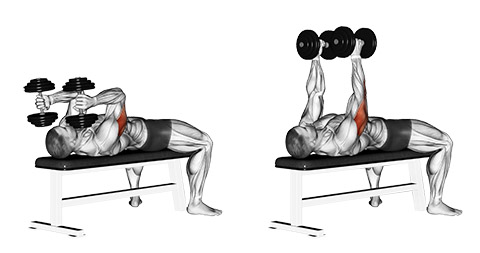
To do a dumbbell skullcrusher, lie on a flat bench, stack elbows over shoulders, and lower the dumbbells by bending only your elbows. It targets the triceps most, with forearms and shoulders stabilizing. Keep your upper arms still so the motion stays at the elbow. The most common mistake is letting elbows drift back, which turns it into a press; fix it by keeping elbows stacked and lowering to the sides of your head. Progress by adding reps at a controlled tempo before increasing load.
Step-by-step form
- Set up: Lie on a flat bench with feet planted and dumbbells above your chest.
- Brace: Keep wrists neutral and stack elbows over shoulders.
- Initiate: Bend only at the elbows and lower the dumbbells beside your head.
- Main rep path: Keep upper arms still as forearms move.
- Hardest point: Pause just above your temples without touching the bench.
- Finish: Extend elbows to lock out without letting them drift.
- Reset: Re-breathe and re-stack elbows before the next rep.
Who this variation is for
This is a good choice for lifters who want triceps overload without a straight bar. Skip it if elbow irritation flares with deep elbow flexion.
- Best fit: Triceps size and lockout strength
- Not ideal when: Elbow pain appears with deep range
- Better option if not ideal: Cable pressdown or close-grip press
Setup and equipment
Small elbow shifts change the movement. Set your position and keep it.
- Setup position: Elbows stacked over shoulders, forearms vertical
- Equipment setup checks: Bench stable, dumbbells matched
- Start load/resistance: A load you can control for 10-15 reps
- Bracing and breathing plan: Inhale on the way down, exhale as you extend
Muscles worked and movement pattern
This is an elbow extension movement with minimal shoulder motion. You should feel the triceps doing most of the work.
| Role | Muscles |
|---|---|
| Primary | Triceps |
| Secondary | Forearms, Anconeus |
| Stabilizers | Shoulders, core |
At a glance
- Variation: Dumbbell skullcrusher
- Best for: Triceps size and lockout strength
- Primary muscles: Triceps
- Equipment: Dumbbells, bench
- Difficulty: Intermediate
- Primary goal: Muscle growth
Technique cues for heavier loads
- Stack elbows over shoulders.
- Keep upper arms still.
- Lower beside your head, not behind it.
- Pause just short of the bench.
- Keep wrists straight and tight.
Common mistakes and how to fix them
| Mistake | Why It Happens | Fix |
|---|---|---|
| Elbows drift back | Load is too heavy or shoulders move | Reduce load and re-stack elbows over shoulders. |
| Turning it into a press | Upper arms move forward | Keep upper arms fixed and slow the lowering. |
| Wrist break | Grip is loose | Squeeze the handles and keep wrists neutral. |
What you should feel
- At the start of each rep: Elbows stacked and shoulders stable
- During lowering or lengthening: Stretch through triceps
- During the hardest point: Triceps working near the bottom
- At lockout or finish: Clean elbow extension without shoulder shift
- If you feel joint pain: Shorten range or switch to a cable pressdown
Regressions (Easier Versions)
- Floor dumbbell skullcrusher with a shorter range
- Rope pressdown to reduce elbow stress
Progressions (Harder Versions)
- Add a 2-second pause near the bottom
- Incline dumbbell skullcrusher once you can do 3 x 12 clean reps
Alternatives by Equipment
| Alternative | When to use it | Why it helps |
|---|---|---|
| Cable pressdown | Elbows feel better with cables | Constant tension and easier elbow path. |
| Close-grip bench press | You want a heavier compound option | Uses triceps with more total load. |
| Overhead triceps extension | You want a long-head emphasis | More stretch at the bottom. |
How many sets and reps to do
Track reps and tempo to keep performance consistent.
For Strength
- Sets: 3-5
- Reps: 6-8
- Rest: 2-3 min
- Frequency: 1-2x/week
- Progression rule: Add load when all sets hit 8 reps with clean form.
For Muscle Growth
- Sets: 3-5
- Reps: 10-15
- Rest: 60-120 sec
- Frequency: 2-3x/week
- Progression rule: Add reps to 15, then increase load.
For Skill / Return to Training
- Sets: 2-3
- Reps: 8-12
- Rest: 60-90 sec
- Frequency: 2x/week
- Progression rule: Improve range and elbow control before load.
4-week example progression
| Week | Sets x reps | Load or difficulty target | Goal |
|---|---|---|---|
| 1 | 3 x 12 | Moderate load | Keep elbows stacked |
| 2 | 3 x 14 | Same load | Add reps without elbow drift |
| 3 | 4 x 10 | +2.5-5% load | Increase intensity |
| 4 | 4 x 12 | Week 3 load | Match tempo every set |
When to increase weight or difficulty
- Performance target: You can complete the top of your rep range with a 2-second eccentric and no elbow drift.
- Readiness check: Both elbows stay stacked from rep 1 to rep 12.
- Next step: Increase each dumbbell by the smallest jump and drop reps by 2.
Safety and Contraindications
Skullcrushers should feel controlled in the elbows. If pain appears, reduce range or switch to cables.
- Stop the set if: Sharp elbow pain or numbness
- Use caution if: You have a recent elbow or triceps tendon flare-up
- Safer substitutions: Cable pressdown, close-grip push-up, machine dip
FAQs
Should the dumbbells touch my head?
No, lower them beside your head and stop just short. Touching risks a bounce and loses tension.
Can I do skullcrushers on an incline bench?
Yes, an incline increases the stretch and can feel harder. Only move there after you can control flat-bench reps.
Why do my elbows flare?
The load is likely too heavy or your shoulders are moving. Reduce load and focus on keeping upper arms fixed.
How far should I lower the dumbbells?
Lower until you feel a triceps stretch without elbow pain. Range will vary slightly by lifter.
Related Exercises
Related Workouts
- No related workouts yet.