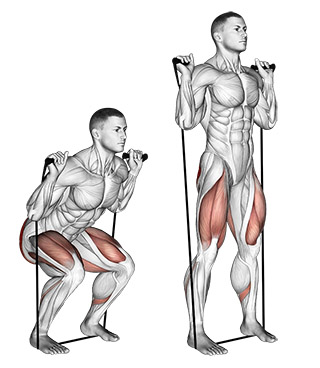
To do a resistance band squat, stand on the band with even tension, bring the band to your shoulders, brace, and squat with full-foot pressure before standing tall. It primarily trains the quadriceps with strong work from glutes and hamstrings. The most common mistake is letting the band go slack or pulling you forward, so keep tension and slow the descent. Progress by adding reps at the same tempo before moving to a thicker band.
Step-by-step form
- Set up: Stand on the band with feet shoulder width and equal tension.
- Brace: Bring the band to your shoulders and tighten your core.
- Initiate: Sit down and back while keeping full-foot pressure.
- Main rep path: Lower in 2-3 seconds to a consistent depth.
- Hardest point: Keep knees tracking toes and chest tall at the bottom.
- Finish: Drive up without letting the band yank you forward.
- Reset: Re-brace and keep the band tension even before each rep.
Who this variation is for
Resistance band squats are a good choice when you want a squat that is portable but still provides progressive resistance.
- Best fit: Advanced trainees who need travel-friendly loading
- Not ideal when: Band setup pulls you forward or irritates shoulders
- Better option if not ideal: Dumbbell squat or bodyweight squat
Setup and equipment
Pick a band thickness that gives tension at the top without forcing you forward.
- Setup position: Feet on the band, hands or loop at shoulder height
- Equipment setup checks: Band sits flat under feet and does not twist
- Start load/resistance: Use a band that allows 8-12 clean reps
- Bracing and breathing plan: Inhale before the descent, exhale near the top
Muscles worked and movement pattern
This is a knee and hip dominant squat with increasing tension near the top. You should feel steady quad and glute effort without the band snapping you out of position.
| Role | Muscles |
|---|---|
| Primary | Quadriceps |
| Secondary | Glutes, hamstrings |
| Stabilizers | Core, calves |
Performance snapshot
- Variation: Resistance band
- Best for: Travel-friendly loading and high-rep work
- Primary muscles: Quadriceps, glutes
- Equipment: Resistance band
- Difficulty: Advanced
- Primary goal: Hypertrophy and control
Technique cues for heavier loads
- Band tension is even on both sides.
- Depth stays consistent across reps.
- Tempo remains smooth with no snap-back.
- Heels stay down through the bottom.
- You can pause at depth for 1 second.
Mistakes that limit your progress
| Mistake | Why It Happens | Fix |
|---|---|---|
| Band goes slack at the bottom | Band is too long or stance too narrow | Widen stance or use a shorter band. |
| Band pulls you forward | Hands are too far in front | Tuck elbows and keep band close to shoulders. |
| Depth changes as fatigue rises | You rush the last reps | Keep a 2-3 second descent on every rep. |
What you should feel
- At the start of each rep: Even band tension and tight core.
- During lowering or lengthening: Quads and glutes loading without wobble.
- During the hardest point: Strong leg drive as tension rises.
- At lockout or finish: Tall posture without leaning back.
- If you feel joint pain: Reduce depth and use a lighter band.
Regressions (Easier Versions)
- Bodyweight squat with a slower tempo.
- Band squat with hands lower and less tension.
Progressions (Harder Versions)
- Band pause squat with a 2-second hold at the bottom.
- Add a thicker band once you can hit 12 clean reps.
Alternatives by Equipment
| Alternative | When to use it | Why it helps |
|---|---|---|
| Dumbbell squat | You have weights available | More stable loading with clear jumps |
| Smith machine squat | You want a fixed bar path | Reduces balance limits |
| Bodyweight squat | You are deloading | Keeps the pattern low stress |
How to keep getting stronger
Keep tension and tempo consistent before changing bands. Record band thickness and depth so progress is measurable.
For Strength
- Sets: 4-6
- Reps: 5-8
- Rest: 2-3 min
- Frequency: 1-2x/week
- Progression rule: Move to a thicker band after two clean sessions.
For Muscle Growth
- Sets: 3-5
- Reps: 10-20
- Rest: 60-120 sec
- Frequency: 2-3x/week
- Progression rule: Add reps to the top of the range, then increase band.
For Skill / Return to Training
- Sets: 2-4
- Reps: 8-12
- Rest: 60-90 sec
- Frequency: 2x/week
- Progression rule: Increase depth and tempo before increasing tension.
4-week example progression
| Week | Sets x reps | Load or difficulty target | Goal |
|---|---|---|---|
| 1 | 3 x 12 | Light band | Lock in depth and balance |
| 2 | 3 x 15 | Same band | Build volume with clean reps |
| 3 | 4 x 12 | Slightly thicker band | Raise tension |
| 4 | 4 x 12-15 | Match week 3 band | Cleaner reps under fatigue |
Progress benchmarks
Use these to decide when to move up a band.
- 15 reps with a 2-second pause at depth
- No slack in the band at the bottom
- Depth stays consistent for all working sets
- You can add a thicker band without losing tempo
Safety and Contraindications
Control the band so it does not yank you forward. Stop the set if you feel sharp joint pain or lose balance.
- Stop the set if: Sharp knee or hip pain or the band snaps you forward
- Use caution if: Shoulder irritation limits where you can hold the band
- Safer substitutions: Dumbbell squat, bodyweight squat, or box squat
FAQs
How thick should the band be?
Pick a band that lets you do 8-12 clean reps with no slack at the bottom. If you can do 15+ reps easily, go thicker.
Where should I hold the band?
Most people hold the band at shoulder height with elbows tucked. If it pulls your shoulders, lower your hands and reduce tension.
Why does the band feel uneven?
Uneven tension usually comes from uneven foot placement. Center the band under both feet and keep your stance even.
Are band squats good for strength?
They can build strength at higher reps, but loading is limited. Use them for volume or travel, then switch to weights for heavy work.
Related Exercises
Related Workouts
- No related workouts yet.