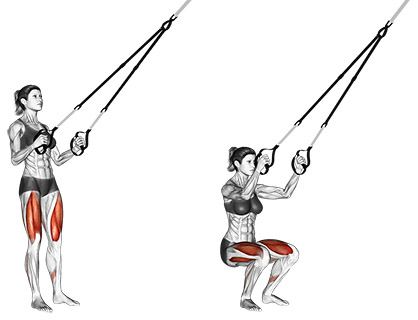
To do a suspension squat, set the straps to a mid-length, hold the handles with light tension, and squat down under control before standing tall. It primarily trains the quadriceps, with strong work from glutes and hamstrings. The most common mistake is leaning back and turning it into a row, so keep your torso upright and only use the straps for balance. Progress by adding reps, then reducing assistance or adding load.
Step-by-step form
- Set up: Set straps to mid-length and face the anchor.
- Brace: Hold the handles with light tension and stand tall.
- Initiate: Sit down and back while keeping heels down.
- Main rep path: Lower in 2-3 seconds to a consistent depth.
- Hardest point: Keep knees tracking toes and chest tall at the bottom.
- Finish: Drive through midfoot without pulling on the straps.
- Reset: Re-brace and keep strap tension even before each rep.
Who this variation is for
Suspension squats are useful for lifters who want consistent depth and balance support while pushing tempo or volume.
- Best fit: Advanced lifters using tempo or high-rep blocks
- Not ideal when: Shoulder or grip pain limits strap use
- Better option if not ideal: Bodyweight squat or dumbbell squat
Setup and equipment
Use the straps for light balance support, not to pull yourself up.
- Setup position: Straps at mid-length, hands at chest height
- Equipment setup checks: Straps are even length and anchor is secure
- Start load/resistance: Bodyweight with light strap tension
- Bracing and breathing plan: Inhale before descent, exhale near the top
Muscles worked and movement pattern
This is a knee and hip dominant squat with a balance assist. You should feel the legs doing the work while the straps only steady you.
| Role | Muscles |
|---|---|
| Primary | Quadriceps |
| Secondary | Glutes, hamstrings |
| Stabilizers | Core, calves |
Performance snapshot
- Variation: Suspension
- Best for: Balance support with controlled depth
- Primary muscles: Quadriceps, glutes
- Equipment: Suspension trainer
- Difficulty: Advanced
- Primary goal: Control and volume
Technique cues for heavier loads
- Strap tension stays light and even.
- Depth stays the same every rep.
- Heels stay down through the bottom.
- Torso stays upright, no backward lean.
- You can pause at depth for 1 second.
Mistakes that limit your progress
| Mistake | Why It Happens | Fix |
|---|---|---|
| Leaning back and pulling | Using straps for effort | Keep arms long and focus on leg drive. |
| Knees cave inward | Hip control fades under fatigue | Slow the descent and drive knees out. |
| Depth changes each rep | Stance or balance shifts | Reset foot position and reduce range. |
What you should feel
- At the start of each rep: Light strap tension and tight core.
- During lowering or lengthening: Quads and glutes loading evenly.
- During the hardest point: Strong leg drive without strap pulling.
- At lockout or finish: Tall posture with stable balance.
- If you feel joint pain: Shorten range and slow the rep.
Regressions (Easier Versions)
- Higher squat depth with more strap tension.
- Box squat using the straps for balance support.
Progressions (Harder Versions)
- Suspension pause squat with a 2-second hold at depth.
- Add load with a weighted vest once you can pause 10 reps.
Alternatives by Equipment
| Alternative | When to use it | Why it helps |
|---|---|---|
| Bodyweight squat | You do not have straps | Keeps the pattern simple |
| Dumbbell squat | You want more loading | Adds strength with free weights |
| Smith machine squat | You want a fixed bar path | Reduces balance limits |
How to keep getting stronger
Track how much help you take from the straps. Reduce assistance before adding load.
For Strength
- Sets: 4-6
- Reps: 6-8
- Rest: 2-3 min
- Frequency: 1-2x/week
- Progression rule: Reduce strap assistance before adding load.
For Muscle Growth
- Sets: 3-5
- Reps: 10-15
- Rest: 60-120 sec
- Frequency: 2-3x/week
- Progression rule: Add reps first, then reduce assistance.
For Skill / Return to Training
- Sets: 2-4
- Reps: 8-12
- Rest: 60-90 sec
- Frequency: 2x/week
- Progression rule: Increase depth and tempo control before load.
4-week example progression
| Week | Sets x reps | Load or difficulty target | Goal |
|---|---|---|---|
| 1 | 3 x 10 | Light strap tension | Own balance and depth |
| 2 | 3 x 12 | Same tension | Build volume with control |
| 3 | 4 x 10 | Less strap help | Increase leg demand |
| 4 | 4 x 12 | Same assistance | Cleaner reps under fatigue |
Progress benchmarks
Use these to decide when to reduce assistance or add load.
- 12 reps with a 2-second pause at depth
- Strap tension stays light across all sets
- Depth stays consistent on the last two reps
- You can reduce assistance without losing posture
Safety and Contraindications
Make sure the anchor is secure and the straps are even. Stop the set if you lose balance or feel sharp joint pain.
- Stop the set if: Sharp knee or hip pain or sudden loss of balance
- Use caution if: Shoulder or grip irritation limits strap holding
- Safer substitutions: Bodyweight squat, box squat, or dumbbell squat
FAQs
How much should I pull on the straps?
Only enough to balance, not enough to lift you. If your arms get tired, you are pulling too much.
Where should I set the straps?
Start at mid-length so the handles are around chest height. Adjust if you cannot keep your torso upright.
Can suspension squats build strength?
They can build strength and control, especially at higher reps. For heavier loading, add a vest or move to dumbbells.
Why do I feel it more in my knees?
Knee stress increases if you shift forward or let the straps pull you. Sit back and keep even foot pressure.
Related Exercises
Related Workouts
- No related workouts yet.