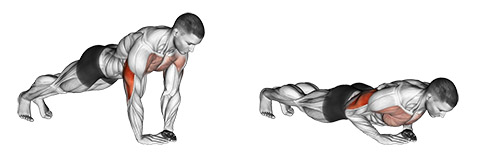
To do a bodyweight diamond push up, place your hands under your chest with thumbs and index fingers touching, brace into a straight line, then lower with elbows tucked and press back up. It targets the triceps most, with the chest helping hard at the bottom. The most common mistake is flaring elbows, so keep them close and think about pushing the floor apart. Progress by adding reps first, then add a slower 3-second lower once you can keep position.
Step-by-step form
- Set up: Get into a plank with hands under the chest and fingers forming a diamond.
- Brace: Squeeze glutes and abs to keep a straight body line.
- Initiate: Shift slightly forward so shoulders stack over hands.
- Main rep path: Lower with elbows close to your ribs.
- Hardest point: Pause just above the floor without losing tension.
- Finish: Press up and fully extend elbows without shrugging.
- Reset: Re-stack ribs over hips and repeat.
Who this variation is for
This is for lifters who already own standard push ups and want more triceps focus without adding external load.
- Best fit: Triceps emphasis and bodyweight strength work
- Not ideal when: Wrist or elbow pain shows up with close hand spacing
- Better option if not ideal: Neutral-grip push up on dumbbells or a narrower standard push up
Setup and equipment
Your hand position and body line decide whether this hits triceps or just stresses joints.
- Setup position: Hands under chest, thumbs and index fingers touching
- Equipment setup checks: Stable floor and enough space for full range
- Start load/resistance: Bodyweight, with a target of 4-8 clean reps
- Bracing and breathing plan: Inhale on the way down, exhale as you press
Muscles worked and movement pattern
Diamond push ups are a horizontal press with a close grip that shifts load toward the triceps. You should still feel chest work at the bottom of the rep.
| Role | Muscles |
|---|---|
| Primary | Triceps |
| Secondary | Chest |
| Stabilizers | Front delts, core, serratus |
At a glance
- Variation: Bodyweight
- Best for: Triceps-focused pressing
- Primary muscles: Triceps
- Equipment: Bodyweight
- Difficulty: Intermediate
- Primary goal: Strength and muscle
How to spot and fix bad form
- Hands under chest, not under the chin.
- Elbows track close, not flared.
- Ribs down and glutes tight.
- Touch the same bottom point each rep.
- Press straight up, not forward.
Why your form breaks down and how to fix it
| Mistake | Why It Happens | Fix |
|---|---|---|
| Elbows flare out | Hands too far forward or grip too wide | Move hands under the chest and tuck elbows. |
| Wrists ache | Hand angle is extreme or range is too deep | Turn hands slightly out or use push up handles. |
| Hips sag or pike | Core tension fades under fatigue | Shorten the set and re-brace before the next rep. |
What you should feel
- At the start of each rep: Straight line from head to heels
- During lowering or lengthening: Triceps and chest loading together
- During the hardest point: Deep triceps effort without elbow pain
- At lockout or finish: Triceps fully extended, shoulders stable
- If you feel joint pain: Switch to neutral-grip push ups or elevate hands
Regressions (Easier Versions)
- Kneeling diamond push up with a shorter lever
- Narrow-hand standard push up without the full diamond shape
Progressions (Harder Versions)
- Tempo diamond push ups with a 3-second lower
- Feet-elevated diamond push ups for more load
Alternatives by Equipment
| Alternative | When to use it | Why it helps |
|---|---|---|
| Triceps rope pushdown | You want load control | Easy to scale and elbows stay supported |
| Close-grip push up | Diamond grip irritates wrists | Similar triceps bias with less wrist strain |
| Bench press dumbbell | You need heavier loading | More range and adjustable load |
How to program around sticking points
Keep diamond push ups 1-3 times per week, depending on your overall pressing volume. Use them as a main press or a triceps finisher.
For Strength
- Sets: 3-5
- Reps: 3-6
- Rest: 2-3 min
- Frequency: 1-2x/week
- Progression rule: Add 1 rep per set until you reach 6, then increase difficulty.
For Muscle Growth
- Sets: 3-4
- Reps: 6-12
- Rest: 60-90 sec
- Frequency: 2-3x/week
- Progression rule: Add reps to the top of the range before making the variation harder.
For Skill / Return to Training
- Sets: 2-3
- Reps: 4-8
- Rest: 60-90 sec
- Frequency: 2-3x/week
- Progression rule: Keep a strict body line before pushing volume.
4-week example progression
| Week | Sets x reps | Load or difficulty target | Goal |
|---|---|---|---|
| 1 | 3 x 5 | Standard diamond | Establish clean range |
| 2 | 3 x 6 | Standard diamond | Add volume without form loss |
| 3 | 4 x 5 | 3-sec lower | Build control under fatigue |
| 4 | 4 x 6 | 3-sec lower | Consolidate progress |
What to do if this exercise hurts
- Likely cause: Elbows or wrists do not tolerate the close grip.
- Immediate modification: Turn hands slightly out or use push up handles.
- Swap option if symptoms persist: Close-grip push up or triceps rope pushdown.
Safety and Contraindications
Diamond push ups should feel challenging but stable. If pain shows up, change hand position or reduce range before you add volume.
- Stop the set if: Sharp wrist or elbow pain appears
- Use caution if: You have a history of wrist or elbow irritation
- Safer substitutions: Close-grip push up, neutral-grip handles, or cable pushdowns
FAQs
Are diamond push ups better than regular push ups?
They are better for triceps emphasis, but not better for everyone. Use them when you want more triceps load and your wrists feel fine.
How close should my hands be?
Start with thumbs and index fingers touching under the chest. If that bothers your wrists, bring hands a little wider and rotate them out.
Why do my shoulders feel pinchy?
Your elbows may be flaring or your hands are too far forward. Reset the hand position and keep elbows tucked as you lower.
How often can I do diamond push ups?
Most people can handle them 1-3 times per week, depending on total pressing work. If elbows get cranky, reduce volume and widen the grip.
Related Exercises
Related Workouts
- No related workouts yet.