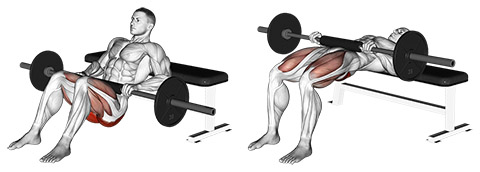
To do a barbell hip thrust, set your upper back on a bench, pad the bar in your hip crease, plant your feet, and drive hips up until your shins are vertical. It targets the glutes most, with hamstrings and core assisting. The most common mistake is overextending the low back at the top; fix it by keeping ribs down and finishing with a glute squeeze, not a back arch. Progress by adding reps at a steady tempo before adding weight.
Step-by-step form
- Set up: Sit on the floor with a bench behind you and the bar over your hips.
- Brace: Pad the bar, then set upper back on the bench edge below your shoulder blades.
- Initiate: Plant feet hip width and pull the bar into your hip crease.
- Main rep path: Drive through mid-foot and lift hips until shins are vertical.
- Hardest point: Squeeze glutes with ribs down and chin slightly tucked.
- Finish: Lower under control until hips hover above the floor.
- Reset: Re-breathe and re-check foot position before the next rep.
Who this variation is for
This is best for lifters who want heavy glute loading and can set up a bar safely. Skip it if the bar or bench setup bothers your hips or back.
- Best fit: Glute strength and size with heavy loading
- Not ideal when: Hip crease or low-back irritation appears with the bar
- Better option if not ideal: Machine hip thrust or dumbbell hip thrust
Setup and equipment
Make setup repeatable so any form issue is easy to spot.
- Setup position: Upper back on bench edge, bar padded in the hip crease
- Equipment setup checks: Bench is stable, bar centered, collars secure
- Start load/resistance: A load you can lift for 8-12 controlled reps
- Bracing and breathing plan: Inhale at the bottom, exhale as you approach lockout
Muscles worked and movement pattern
This is a hip extension pattern with a short range of motion and high glute tension. You should feel glutes doing most of the work, not your lower back.
| Role | Muscles |
|---|---|
| Primary | Glutes |
| Secondary | Hamstrings, Adductors |
| Stabilizers | Core, spinal erectors, abductors |
At a glance
- Variation: Barbell hip thrust
- Best for: Glute strength and muscle growth
- Primary muscles: Glutes
- Equipment: Barbell, bench, pad
- Difficulty: Intermediate
- Primary goal: Muscle growth
How to spot and fix bad form
- Ribs stay down at the top, not flared.
- Shins are vertical at lockout, not angled forward.
- Bar stays level on the hip crease.
- Glutes do the work, not your lower back.
- Tempo stays the same from rep 1 to rep 10.
Common mistakes and how to fix them
| Mistake | Why It Happens | Fix |
|---|---|---|
| Overextending the low back | Ribs flare and you chase height | Keep ribs down and finish by squeezing glutes, not arching. |
| Feet too far from your hips | You feel hamstrings more than glutes | Walk feet closer so shins are vertical at the top. |
| Bar rolls or pinches | Bar is too high or not padded | Center the bar in the hip crease and use a thick pad. |
What you should feel
- At the start of each rep: Bar stable in the hip crease and core braced
- During lowering or lengthening: Tension in glutes and hamstrings
- During the hardest point: Strong glute squeeze, no low-back pinch
- At lockout or finish: Hips level with ribs stacked over hips
- If you feel joint pain: Reduce range and switch to a pad or machine
Regressions (Easier Versions)
- Bodyweight hip thrust with a controlled pause at the top
- Glute bridge from the floor with a shorter range
Progressions (Harder Versions)
- Add a 2-second pause at lockout for every rep
- Add 2.5-5% load after hitting the top rep target twice
Alternatives by Equipment
| Alternative | When to use it | Why it helps |
|---|---|---|
| Machine hip thrust | Bar setup bothers your hips | Keeps load centered with less setup pain. |
| Dumbbell hip thrust | You train at home | Easier setup with a single dumbbell. |
| Cable pull-through | You want a hinge pattern | Trains glutes without the bench setup. |
How many sets and reps to do
Choose a track based on your goal, then keep tempo and range consistent across sets.
For Strength
- Sets: 4-6
- Reps: 3-6
- Rest: 2-4 min
- Frequency: 1-2x/week
- Progression rule: Add 2.5-5% when all sets hit 6 reps with full lockout.
For Muscle Growth
- Sets: 3-5
- Reps: 8-12
- Rest: 90-150 sec
- Frequency: 2-3x/week
- Progression rule: Add reps to the top of the range, then add load.
For Skill / Return to Training
- Sets: 2-4
- Reps: 8-10
- Rest: 60-120 sec
- Frequency: 2x/week
- Progression rule: Improve range and glute squeeze before load.
4-week example progression
| Week | Sets x reps | Load or difficulty target | Goal |
|---|---|---|---|
| 1 | 3 x 10 | Moderate load | Learn foot placement and lockout |
| 2 | 3 x 12 | Same load | Add reps without back arching |
| 3 | 4 x 8 | +2.5-5% load | Increase intensity |
| 4 | 4 x 10 | Week 3 load | Keep shins vertical every rep |
What to do if this exercise hurts
- If your low back feels pinchy, lower the lockout and keep ribs down.
- If the bar hurts your hips, use a thicker pad or switch to a machine.
- If your knees feel strained, move feet slightly closer and push through mid-foot.
Safety and Contraindications
Hip thrusts should feel strong in the glutes, not sharp in the low back. If pain shows up, change the setup before you change the load.
- Stop the set if: Sharp low-back pain, hip pinching, or numbness
- Use caution if: You have a recent hip or lumbar strain
- Safer substitutions: Machine hip thrust, glute bridge, cable pull-through
FAQs
How high should I thrust the bar?
Lift until your shins are vertical and ribs are stacked over hips. Higher usually means your low back is taking over.
Where should the bench hit my back?
Set the bench edge just below the shoulder blades. Too high limits range and too low makes control harder.
Should I tuck my chin?
A slight chin tuck helps keep ribs down. Do not force it; just keep a neutral neck.
Why do I feel hip thrusts in my hamstrings?
Your feet are probably too far away. Walk them in so your shins are vertical at the top.
Related Exercises
Related Workouts
- No related workouts yet.