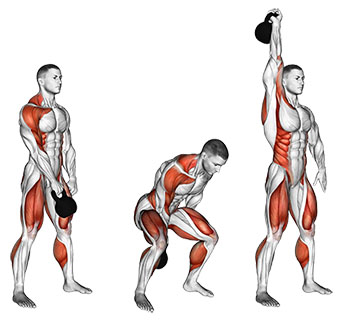
To do a kettlebell snatch, hinge hard, swing the bell close to your body, then punch through the handle into a locked-out overhead position. It trains glutes and hamstrings most, with traps and shoulders finishing the rep. The most common mistake is letting the bell flop onto the wrist, so keep it close and rotate your hand around the handle at the top. Progress by adding reps or a slightly heavier bell once every set stays smooth.
Step-by-step form
- Set up: Place the bell a foot in front of you and stand hip-width.
- Brace: Hinge back, grip the handle, and keep ribs down.
- Initiate: Hike the bell back between the legs like a swing.
- Main rep path: Drive hips forward and keep the bell close to your body.
- Hardest point: Punch your hand through the handle to catch overhead.
- Finish: Stand tall with elbow locked and biceps near ear.
- Reset: Guide the bell down and hike it back for the next rep.
Who this variation is for
This variation is for beginners who already know the kettlebell swing and want to learn the snatch safely with lighter loads.
- Best fit: Building power and cardio with a single bell
- Not ideal when: Overhead positions feel painful or unstable
- Better option if not ideal: Two-hand kettlebell swing
Setup and equipment
Pick a bell that lets you stay smooth and quiet at the top, not one that slams the wrist.
- Setup position: Feet hip-width, bell slightly in front, hinge loaded
- Equipment setup checks: Handle is dry and the floor is clear
- Start load/resistance: Light bell you can control for 6-10 reps per side
- Bracing and breathing plan: Exhale as you drive hips, inhale during the drop
Muscles worked and movement pattern
The kettlebell snatch is a hip hinge that ends overhead. You should feel explosive hip drive and a crisp lockout without shoulder pinch.
| Role | Muscles |
|---|---|
| Primary | Glutes, hamstrings |
| Secondary | Traps, shoulders |
| Stabilizers | Core, grip, upper back |
At a glance
- Variation: Kettlebell
- Best for: Power and conditioning
- Primary muscles: Glutes, hamstrings
- Equipment: Kettlebell
- Difficulty: Intermediate
- Primary goal: Power and cardio
Form tips for better reps
- Keep the bell close on the way up.
- Hinge first, then snap hips.
- Punch through at the top to avoid wrist bang.
- Lock out overhead with ribs down.
- Let the bell fall, do not pull it down.
Common mistakes and how to fix them
| Mistake | Why It Happens | Fix |
|---|---|---|
| Bell slams the wrist | Late hand rotation | Punch through earlier and keep the bell close. |
| Squatting the rep | Hips are not snapping | Practice swings and think hinge, not squat. |
| Arm pulling the bell up | Trying to lift with the shoulder | Drive hips first and let the bell float. |
What you should feel
- At the start of each rep: Hips loaded and core braced
- During lowering or lengthening: Bell falling under control, shoulders relaxed
- During the hardest point: Hip snap driving the bell up
- At lockout or finish: Bell stacked over shoulder and hip
- If you feel joint pain: Stop overhead work and switch to swings
Regressions (Easier Versions)
- Two-hand kettlebell swing when the snatch feels rushed
- One-arm kettlebell high pull to learn the path
Progressions (Harder Versions)
- Heavier bell while keeping the same rep speed
- Longer sets with controlled breathing, 30-60 seconds per side
Alternatives by Equipment
| Alternative | When to use it | Why it helps |
|---|---|---|
| Barbell deadlift | You want strength focus | Builds hinge strength without overhead work |
| Hip thrust machine | You want glute drive with support | Emphasizes hip extension safely |
| Rowing machine | You want conditioning without overhead | Full-body cardio with less shoulder demand |
How many sets and reps for beginners
Keep the reps short and clean so form does not break down. Train 1-3 times per week depending on other hinge work.
For Strength
- Sets: 4-6
- Reps: 3-5 per side
- Rest: 2-3 min
- Frequency: 1-2x/week
- Progression rule: Add 1 rep per side before increasing bell size.
For Muscle Growth
- Sets: 3-4
- Reps: 6-10 per side
- Rest: 90-120 sec
- Frequency: 1-2x/week
- Progression rule: Add reps to the top of the range, then add weight.
For Skill / Return to Training
- Sets: 2-3
- Reps: 4-6 per side
- Rest: 90 sec
- Frequency: 2-3x/week
- Progression rule: Smooth rep path before adding speed or load.
4-week example progression
| Week | Sets x reps | Load or difficulty target | Goal |
|---|---|---|---|
| 1 | 3 x 5/side | Light bell | Clean path and quiet catch |
| 2 | 3 x 6/side | Same bell | Build volume without wrist bang |
| 3 | 4 x 5/side | Slightly heavier bell | Add load with control |
| 4 | 4 x 6/side | Same bell | Consolidate technique |
Checklist before your first set
- Bell is light enough for a quiet catch.
- You can hinge without rounding your back.
- Overhead lockout feels stable and pain free.
- There is clear space around you.
Safety and Contraindications
The snatch should feel fast and smooth, not jarring. If shoulders or wrists hurt, lower the load or switch to swings.
- Stop the set if: Sharp shoulder or wrist pain appears
- Use caution if: You have limited overhead mobility or recent shoulder injury
- Safer substitutions: Two-hand swing, one-arm high pull, or rowing machine
FAQs
Should I learn the swing first?
Yes. A clean swing teaches the hinge and timing you need for a safe snatch.
Why does the bell hit my forearm?
The hand is rotating too late. Keep the bell close and punch through earlier at the top.
How heavy should the bell be?
Start lighter than you think. If you cannot keep a smooth catch, the bell is too heavy.
Can I do snatches for cardio?
Yes, but keep sets short and crisp. Use intervals so your form does not fall apart.
Related Exercises
Related Workouts
- No related workouts yet.