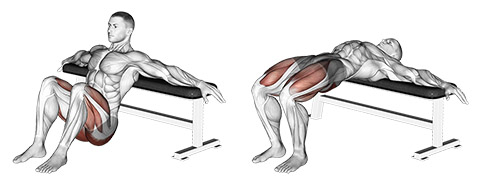
To do a bodyweight hip thrust, place your upper back on a bench, plant your feet hip width, and drive your hips up until your shins are vertical. It targets the glutes most, with hamstrings and core assisting. The most common mistake is pushing too high and arching the low back; fix it by keeping ribs down and finishing with a glute squeeze. Keep knees tracking over toes so the load stays in the glutes. Progress by adding reps or a longer top pause before adding external load.
Step-by-step form
- Set up: Sit on the floor with a bench behind you.
- Brace: Set your upper back on the bench edge below the shoulder blades.
- Initiate: Plant feet hip width and pull heels slightly toward you.
- Main rep path: Drive through mid-foot and lift hips smoothly.
- Hardest point: Stop when shins are vertical and ribs stay down.
- Finish: Hold a 1-second squeeze at the top.
- Reset: Lower under control to the floor and re-breathe.
Who this variation is for
This is a good entry point for learning hip extension without heavy loading. Skip it if bench pressure or back discomfort makes it hard to keep a neutral spine.
- Best fit: Learning glute-driven hip extension
- Not ideal when: Bench contact or back position feels uncomfortable
- Better option if not ideal: Glute bridge from the floor
Setup and equipment
Your setup should feel stable and repeatable from set to set.
- Setup position: Upper back on the bench, feet flat and hip width
- Equipment setup checks: Bench is stable, floor is not slippery
- Start load/resistance: Bodyweight only with smooth reps
- Bracing and breathing plan: Inhale at the bottom, exhale near lockout
Muscles worked and movement pattern
This is a hip extension movement with a short range. You should feel the glutes take the lead rather than the lower back.
| Role | Muscles |
|---|---|
| Primary | Glutes |
| Secondary | Hamstrings, Adductors |
| Stabilizers | Core, spinal erectors |
At a glance
- Variation: Bodyweight hip thrust
- Best for: Glute activation and pattern learning
- Primary muscles: Glutes
- Equipment: Bench or sturdy box
- Difficulty: Beginner
- Primary goal: Skill and muscle endurance
How to spot and fix bad form
- Ribs stay down, no low-back arching.
- Shins are vertical at the top.
- Hips rise and lower together, no twisting.
- Heels stay planted through the rep.
- Tempo stays smooth without bouncing.
Common mistakes and how to fix them
| Mistake | Why It Happens | Fix |
|---|---|---|
| Overextending at the top | Trying to get higher | Stop when shins are vertical and squeeze glutes only. |
| Feet too far away | Hamstrings take over | Walk feet closer to the bench. |
| Hips drop between reps | Losing tension or rushing | Pause briefly at the top, then lower slowly. |
What you should feel
- At the start of each rep: Stable bench contact and core tension
- During lowering or lengthening: Stretch through glutes and hamstrings
- During the hardest point: Strong glute squeeze, not low-back strain
- At lockout or finish: Hips level with ribs stacked
- If you feel joint pain: Reduce range and shorten the hold
Regressions (Easier Versions)
- Glute bridge from the floor with a shorter range
- Isometric top holds for 10-20 seconds
Progressions (Harder Versions)
- Add a 3-second pause at the top of each rep
- Move to a dumbbell hip thrust when reps are easy
Alternatives by Equipment
| Alternative | When to use it | Why it helps |
|---|---|---|
| Glute bridge | You cannot use a bench | Same pattern with less range. |
| Machine hip thrust | You want more stability | Machine support makes loading easier. |
| Cable pull-through | You prefer a hinge pattern | Trains glutes with less hip pressure. |
How many sets and reps to do
Keep reps smooth and stop short of back arching.
For Strength
- Sets: 3-5
- Reps: 6-10
- Rest: 2-3 min
- Frequency: 1-2x/week
- Progression rule: Add reps first, then add a small load.
For Muscle Growth
- Sets: 3-4
- Reps: 10-15
- Rest: 60-120 sec
- Frequency: 2-3x/week
- Progression rule: Add reps or pause length before load.
For Skill / Return to Training
- Sets: 2-3
- Reps: 8-12
- Rest: 60-90 sec
- Frequency: 2x/week
- Progression rule: Improve range and control before load.
4-week example progression
| Week | Sets x reps | Load or difficulty target | Goal |
|---|---|---|---|
| 1 | 3 x 10 | Bodyweight | Own the setup and top position |
| 2 | 3 x 12 | Bodyweight | Add reps with smooth tempo |
| 3 | 3 x 12 | 2-second top pause | Increase time under tension |
| 4 | 4 x 10 | Longer pause | Keep ribs down and hips level |
What to do if this exercise hurts
- If your low back feels pinchy, reduce the range and focus on rib position.
- If bench pressure bothers you, use a pad or switch to a floor bridge.
- If knees feel stressed, move feet slightly closer and drive through mid-foot.
Safety and Contraindications
Hip thrusts should feel strong in the glutes, not sharp in joints. Adjust setup before you add volume.
- Stop the set if: Sharp pain in the low back, hips, or knees
- Use caution if: You have a recent hip or lumbar strain
- Safer substitutions: Glute bridge, cable pull-through, machine hip thrust
FAQs
Should I feel this in my lower back?
No, the effort should be in the glutes. If your lower back takes over, shorten range and keep ribs down.
How close should my feet be?
Close enough that your shins are vertical at the top. If your heels lift, you are too close.
Can I do this on the floor without a bench?
Yes, a glute bridge from the floor is a good regression. It is easier to control and still targets the glutes.
When should I add weight?
Add load after you can do 3-4 sets of 12-15 clean reps with a 1-2 second pause.
Related Exercises
Related Workouts
- No related workouts yet.