How to Do the Machine Bicep Curl (Form, Muscles Worked, Mistakes)
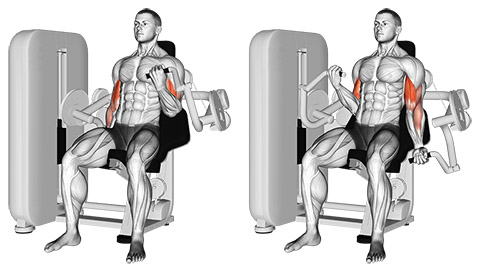
To do the machine bicep curl, adjust the seat so the pivot matches your elbow, curl smoothly, squeeze, then lower under control. It mainly trains your biceps with less swinging, so it’s great for strict reps near failure.
What Muscles Does Machine Bicep Curl Work?
Machine bicep curls primarily train the biceps, with the brachialis and forearm muscles assisting to flex the elbow while the machine provides stability so you can focus on a controlled contraction.
| Muscle group | Role | What it does in this lift |
|---|---|---|
| Biceps (biceps brachii) | Primary | Flexes the elbow against the machine’s resistance curve. |
| Brachialis | Secondary | Assists elbow flexion, often felt deeper in the upper arm. |
| Brachioradialis + forearm flexors | Secondary / Stabilizer | Helps stabilize grip and wrist position on the handles. |
| Upper back + rotator cuff | Stabilizer | Keeps shoulders set so you don’t shrug through reps. |
How Do You Perform Machine Bicep Curl?
Set the seat so the machine’s pivot lines up with your elbow, grip the handles, curl smoothly without lifting your shoulders, squeeze at the top, then lower under control until your elbow is straight again without bouncing off the stop.
- Adjust the machine: Set the seat and arm pad so your elbows line up with the machine’s pivot point.
- Set your body: Keep your chest up and shoulders down; plant your feet and keep your back against the support if there is one.
- Grip: Hold the handles with a comfortable grip; keep wrists straight.
- Curl: Curl the handles up by bending your elbows—don’t shrug your shoulders up to “help.”
- Squeeze: Pause at the top for a beat and feel the biceps contract.
- Lower: Lower for 2–3 seconds to full elbow extension without slamming the weight stack.
- Repeat smoothly: Keep rep speed consistent, especially on the last few reps.
What Are the Benefits of Machine Bicep Curl?
Machine curls make it easier to train your biceps hard with strict form, because the machine reduces balance demands and limits cheating.
- Strict reps are easier: The guided path reduces swinging and momentum.
- Stable when fatigued: Useful late in a workout when free-weight curls get sloppy.
- Repeatable setup: Once the seat and pivot are dialed in, reps tend to look the same week to week.
- Good for higher reps: Many people can push closer to failure safely with a controlled machine curl.
What Are Common Machine Bicep Curl Mistakes?
The most common machine curl mistake is setting the seat wrong so your elbows don’t line up with the pivot, which makes the movement feel awkward and harder on the joints.
Is the seat height/pad position misaligned?
Problem: The curl feels “off,” and you feel it in wrists or elbows instead of biceps.
Why it happens: Your elbow joint isn’t lining up with the machine’s pivot.
Fix: Adjust the seat/pad so your elbow sits at the axis of rotation before you start your sets.
Are you shrugging your shoulders to finish reps?
Problem: Your shoulders rise and the rep turns into a trap/front-delt movement.
Why it happens: The weight is too heavy or you’re rushing the top.
Fix: Lower the weight and keep your shoulders down; stop when your forearm is near vertical if the machine’s range is limited.
Are you bouncing off the bottom or slamming the stack?
Problem: You lose tension and your elbows take a beating.
Why it happens: Too heavy or too fast.
Fix: Slow the lowering to 2–3 seconds and reverse the rep smoothly—no bounce.
Are you using a short range of motion?
Problem: Half reps that never fully straighten or fully curl.
Why it happens: Ego weight or trying to keep tension by cutting range.
Fix: Use a full pain-free range and keep tension with slower tempo instead of shorter reps.
Is Machine Bicep Curl Good for Beginners?
Yes. Once the machine is adjusted correctly, it’s one of the easiest ways to learn what a strict curl should feel like. Start light, move smoothly, and use the same setup each time so you can progress without guessing.
How Much Weight Should You Use for Machine Bicep Curl?
Choose a weight you can lift without shrugging or bouncing, keeping the stack smooth. A simple rule: pick a load you can do for 10–15 strict reps with 1–3 reps in reserve.
| Goal | Sets | Reps | Rest | Effort cue |
|---|---|---|---|---|
| Strength focus | 3–5 | 6–10 | 90–150 sec | Clean reps, no shoulder shrug. |
| Size (hypertrophy) | 2–4 | 10–20 | 60–120 sec | Slow lower, hard squeeze. |
| Controlled finisher | 1–3 | 15–30 | 30–60 sec | Light load, smooth tempo. |
Progression idea: keep weight the same until you can add 2–4 reps per set, then bump the stack by the smallest increment.
How Often Should You Do Machine Bicep Curl?
Most people do well with 2–3 machine curl sessions per week, especially if they’re already doing plenty of pulling. Put machine curls after back work, or use them as your “strict” curl on days when free-weight curls usually turn into swings.
How Does Machine Bicep Curl Compare to Dumbbell Bicep Curl?
Machine curls are more guided and consistent, while dumbbells let you rotate your wrist and train each arm independently with more freedom.
| Option | Best for | Tradeoff |
|---|---|---|
| Machine bicep curl | Strict reps, stable setup, pushing close to failure | Machine design varies; pivot setup matters a lot. |
| Dumbbell bicep curl | Wrist rotation and unilateral balance | Easier to cheat with body swing when fatigued. |
What Are the Best Alternatives to Machine Bicep Curl?
If a machine doesn’t fit your body well (or you don’t have access), free-weight and cable curls can train the same muscles with different tension and freedom.
Alternative Exercises


Cable bicep curl
Best for: Constant tension and smooth, controlled reps.
Key difference: The cable keeps tension through more of the range.
Difficulty: Easy to scale and great for higher reps.
Dumbbell bicep curl
Best for: Natural wrist rotation and unilateral balance.
Key difference: Each arm works independently; you can supinate as you curl.
Difficulty: Easy to progress but easy to cheat if you rush.
Barbell bicep curl
Best for: Simple loading and repeatable sets.
Key difference: Fixed hand position and shared bar.
Difficulty: Keep it strict to protect elbows and wrists.
What Equipment Do You Need?
- Bicep curl machine: Seated curl machines and preacher-style machines both count—just make sure you can adjust the seat/pad.
- Selectorized stack or plate-loaded machine: Either works; the main difference is how easy it is to make small load jumps.
- Optional: towel grip (advanced): If your machine handles are slick, a towel can help, but don’t let grip be the limiter for biceps work.
A Quick Machine Setup Checklist
- Pivot aligned: Your elbow lines up with the machine’s axis of rotation.
- Shoulders down: No shrugging at the top.
- Full range: Straighten the elbow at the bottom without bouncing; curl to a strong top position without slamming.
Frequently Asked Questions
Build your plan with Momentum.
Get structured workouts based on your goals, equipment, and training history.