How to Do the Dumbbell Bent-Over Row (Form, Muscles Worked, Mistakes)
The dumbbell bent-over row is a lat-focused row that lets each arm move naturally. Hinge and brace, pull the dumbbells toward your hips with elbows driving back, then lower slowly to a stretch. Use it for back volume, shoulder-friendly grips, and home workouts.
What Muscles Does the Dumbbell Bent-Over Row Work?
The dumbbell bent-over row primarily trains your lats and upper back to pull your elbows behind you and control your shoulder blades. Your biceps assist the pull, while your lower back and core brace the hinge so you can row without your torso shifting.
| Role | Muscles | Function |
|---|---|---|
| Primary | Lats, mid traps/rhomboids | Pulls the upper arm back and controls shoulder blade movement. |
| Secondary | Rear delts, biceps, forearms | Assists the pull and supports grip strength. |
| Stabilizers | Lower back, glutes, abdominals | Holds a steady hinge and prevents torso sway. |
How Do You Perform the Dumbbell Bent-Over Row?
Hinge into a stable torso angle with a flat back, brace your core, pull the dumbbells toward your hips with elbows driving back, then lower them under control until your arms are straight again without changing your torso position.
- Stance: Stand hip-width holding two dumbbells; soften knees and keep feet planted.
- Hinge: Push hips back until your torso is stable (roughly 30-45 degrees), keeping a neutral spine.
- Grip: Start with a neutral grip (palms facing) unless an overhand grip feels better for you.
- Brace: Inhale and brace; keep ribs down and neck neutral.
- Row: Pull dumbbells toward your hips (not straight up to the shoulders) while driving elbows back.
- Top position: Briefly pause when elbows are behind the torso; keep shoulders away from ears.
- Lower: Lower slowly until arms are straight and you feel a stretch in the lats.
- Repeat: Keep the hinge still; if you start rocking or standing up, end the set or reduce weight.
What Are the Benefits of the Dumbbell Bent-Over Row?
The dumbbell bent-over row builds lats and upper back with flexible grip options and a large range of motion.
- Grip flexibility: Neutral or semi-neutral grips can feel better for many shoulders than a fixed barbell grip.
- Great range of motion: Dumbbells can travel slightly deeper and let you row toward the hip without the bar hitting your legs.
- Minimal equipment: All you need is a pair of dumbbells and enough space to hinge.
- Easy progression: Add reps, add weight, or add a 1-second pause at the top without changing the exercise.
What Are Common Dumbbell Bent-Over Row Mistakes?
The most common mistake is twisting or rocking your torso to move heavier dumbbells.
Are you twisting to row one side higher?
Problem: One dumbbell hits higher, your hips shift, and the set feels uneven. Why it happens: The weight is too heavy or your stance is unstable. Fix: Widen your stance slightly, lighten the load, and row both dumbbells to the same point near your hips.
Are you shrugging instead of rowing?
Problem: You feel the upper traps more than the lats. Why it happens: You pull elbows up and let shoulders rise. Fix: Drive elbows back and keep shoulders down; pause briefly with shoulder blades set.
Are you turning it into a partial rep?
Problem: You stop early and never reach a stretch at the bottom. Why it happens: The weight is too heavy or you rush the tempo. Fix: Lower until arms are straight, slow the eccentric, and use a lighter weight if needed.
Is your lower back rounding as the set goes on?
Problem: The hinge collapses and you feel the spine doing the work. Why it happens: Fatigue and poor bracing. Fix: Raise the torso angle, brace before each rep, and shorten the set (more sets, fewer reps) until you build endurance.
Is the Dumbbell Bent-Over Row Good for Beginners?
Yes. Start with light dumbbells, keep your torso angle higher, and use a neutral grip. If holding the hinge is hard, do chest-supported dumbbell rows on an incline bench until your bracing improves.
How Much Weight Should You Use for the Dumbbell Bent-Over Row?
Choose a weight you can row with a steady torso and full range of motion, usually leaving 1-3 reps in reserve (RIR). If you have to twist, shorten the range, or stand up between reps, the dumbbells are too heavy for the goal.
| Goal | Sets | Reps | Rest | Effort |
|---|---|---|---|---|
| Strength | 3-5 | 6-10 | 2-3 min | 1-2 RIR |
| Hypertrophy | 3-4 | 8-15 | 90-150 sec | 1-3 RIR |
| Technique / tempo | 2-4 | 10-15 | 60-120 sec | 2-4 RIR |
Simple 4-week progression (hypertrophy): Week 1 3x10, Week 2 3x11, Week 3 3x12, Week 4 add 5 lb per dumbbell and repeat at 3x10.
How Often Should You Do the Dumbbell Bent-Over Row?
2-3 times per week is common because dumbbell rows are easy to recover from compared to heavier barbell hinges. Use them as your main row on upper-body days, or as a secondary lift after a heavier barbell row or deadlift day.
How Does the Dumbbell Bent-Over Row Compare to the Barbell Bent-Over Row?
Dumbbells give you more grip and path freedom and can be easier on the shoulders, while a barbell often lets you load heavier and keep both arms perfectly synced.
| Comparison | Dumbbells | Barbell |
|---|---|---|
| Grip options | Neutral/semi-neutral available | Mostly fixed overhand/underhand |
| Range of motion | Often slightly larger | Can be limited by thighs/torso |
| Loading potential | Moderate to heavy | Often heaviest option |
What Are the Best Alternatives to the Dumbbell Bent-Over Row?
If you want more support, choose a chest-supported row; if you want a different resistance curve or home setup, use cables or bands.
Alternative Exercises



Chest-Supported Dumbbell Row (Incline Bench)
Best for: Training the back hard without hinge fatigue. Key difference: Bench support keeps torso still. Difficulty: Low to moderate.
One-Arm Dumbbell Row (Bench-Supported)
Best for: Unilateral control and long range of motion. Key difference: You can focus on one side and adjust the path easily. Difficulty: Moderate.
Seated Cable Row
Best for: Smooth resistance and strict reps in higher rep ranges. Key difference: Easier to keep constant tension without grip or hinge being the limiter. Difficulty: Low to moderate.
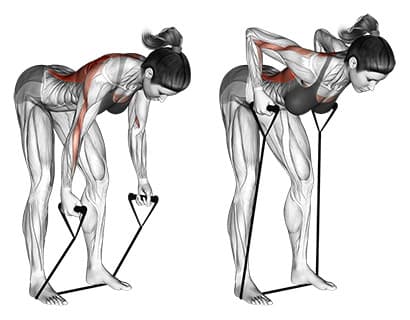
Resistance Band Row
Best for: Home training and high-rep back work. Key difference: Resistance increases as the band stretches, so it is hardest near the top. Difficulty: Low to moderate.
What Equipment Do You Need?
- Required: a pair of dumbbells and enough floor space to hinge safely.
- Helpful: an incline bench if you want a chest-supported variation, and chalk if grip is limiting.
- Optional: lifting straps for heavier sets if you are trying to emphasize the back more than grip.
Frequently Asked Questions
Build your plan with Momentum.
Get structured workouts based on your goals, equipment, and training history.