How to Do Ball Slams (Medicine Ball Slam) With Proper Form
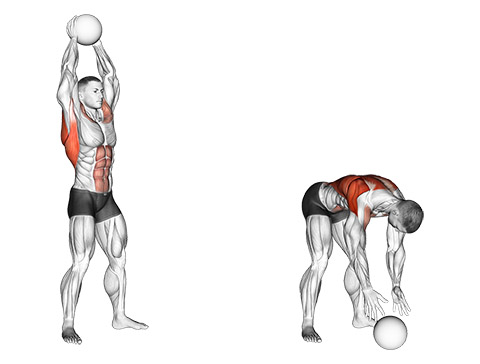
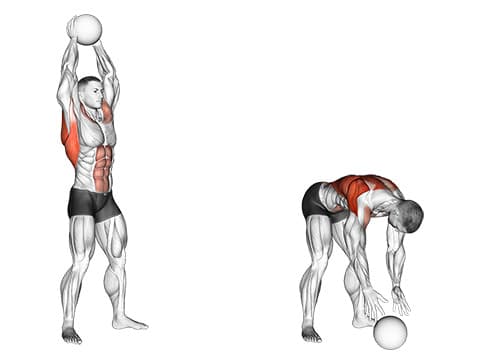
Ball slams (medicine ball slams) are a fast, full-body power exercise that mainly trains your abs and lats while spiking your heart rate. Lift the ball overhead, brace hard, and slam it straight down with control. They’re great for athletes and anyone who wants conditioning without running.
What Muscles Does Ball Slams Work?
Ball slams primarily train your abdominals to brace and transmit force, with your lats helping you pull the ball down fast and keep your shoulders “packed.” Your hips and legs add power on the pickup and drive, while your arms finish the slam.
| Role | Muscles | What they do |
|---|---|---|
| Primary | Abdominals | Brace your torso so you can transfer force overhead-to-floor without overextending your lower back. |
| Secondary | Lats | Pull the ball down aggressively and help keep your shoulders stable as the ball changes direction. |
| Assist | Glutes, quads | Help you hinge/squat to pick up the ball and drive the reset between reps. |
| Assist | Shoulders, triceps, grip | Guide the ball overhead and control the release so you can repeat reps cleanly. |
How Do You Perform Ball Slams?
Pick up a slam ball, raise it overhead with your ribs down, then brace your midsection and slam the ball straight down between your feet; reset by hinging to grab it again while keeping your back neutral and your pace consistent.
- Set up: Stand with feet about hip-width and the ball on the floor in front of you; give yourself space so you can slam straight down without hitting anything.
- Pick it up: Hinge back (like a short deadlift), grab the ball, and stand tall. Keep your back neutral and the ball close to your body.
- Go overhead: Bring the ball overhead until your biceps are near your ears. Keep a soft bend in your elbows, ribs down (don’t lean back), and lightly squeeze your glutes.
- Brace: Take a quick breath in and tighten your abs like you’re about to be poked in the stomach.
- Slam: Drive the ball straight down with your lats and arms while snapping into a strong brace. Exhale hard as the ball hits the floor.
- Reset: Hinge to grab the ball again, then repeat. If your low back starts doing the work, slow down and shorten the set.
What Are the Benefits of Ball Slams?
Ball slams build explosive power and conditioning at the same time, without needing a lot of skill or equipment.
- Power output: You can move a light-to-moderate load very fast, which is useful for athletic training.
- Conditioning without impact: Great option if running or jumping bothers your joints but you still want to breathe hard.
- Trunk bracing under speed: The overhead-to-floor pattern forces you to brace quickly and repeatedly.
- Upper-back engagement: Your lats and upper back do real work controlling the overhead position and pulling down hard.
What Are Common Ball Slams Mistakes?
The most common mistake is letting your lower back arch as you take the ball overhead.
Are you leaning back overhead?
Problem: You finish the overhead position with flared ribs and a big lower-back arch.
Why it happens: The ball is too heavy, or you’re chasing “height” instead of staying stacked.
Fix: Use a lighter ball, keep your ribs down, and stop the overhead raise where you can stay tall (arms overhead, not hips forward).
Are you slamming with your arms only?
Problem: The slam feels slow, and your shoulders burn more than your abs and lats.
Why it happens: You’re not bracing, and you’re not using your lats to pull the ball down.
Fix: Think “brace, then pull down.” Tighten your abs before the slam and drive the ball down with your lats like a straight-arm pulldown.
Are you rounding your back on the pickup?
Problem: You fold over the ball and tug it up with a rounded spine.
Why it happens: You’re rushing the reset or the ball is awkward/heavy.
Fix: Slow down, hinge back, and grab the ball with a neutral back. If you can’t, shorten the set or use a lighter ball.
Are you using the wrong ball (or bouncing it)?
Problem: The ball rebounds unpredictably, pulling you out of position.
Why it happens: A standard medicine ball bounces; a slam ball is designed not to.
Fix: Use a slam ball when possible. If you only have a bouncy med ball, keep reps controlled and don’t chase the bounce.
Is Ball Slams Good for Beginners?
Yes—most beginners can learn ball slams quickly if they start with a light ball and keep the overhead position stacked (ribs down, glutes lightly tight). If overhead lifting irritates your shoulders, raise the ball only to eye level and slam from there until your shoulders tolerate full range.
How Much Weight Should You Use for Ball Slams?
Use a ball that you can slam hard without leaning back overhead or rounding your back on the pickup. For many people, that’s 6–20 lb to start; stronger athletes may use 20–40+ lb, but only if speed and posture stay clean.
| Goal | Sets | Reps / Time | Rest | How it should feel |
|---|---|---|---|---|
| Power | 4–8 | 3–6 reps | 60–120 sec | Every rep is fast; you could do a couple more reps if you had to. |
| Conditioning | 3–6 | 10–20 reps | 45–90 sec | You’re breathing hard, but posture stays solid. |
| Finisher | 4–10 min | 10 sec on / 20–30 sec off | — | Short bursts; stop if your back position breaks. |
Progression (simple 4-week): Week 1 pick a weight you can slam cleanly for 3×10. Week 2 add reps (3×12). Week 3 add a set (4×10–12). Week 4 keep volume and go slightly heavier—or keep weight and shorten rest by ~10–15 seconds.
How Often Should You Do Ball Slams?
1–3 times per week works well for most people.
- As a warm-up primer: 3–5 sets of 3–5 powerful reps before strength work.
- As conditioning: 3–6 sets of 10–20 reps, or timed intervals.
- Pairing ideas: superset with goblet squats, kettlebell swings, or sled pushes for a simple “power + legs” circuit.
If your hamstrings or lower back are already smoked from heavy hinging (deadlifts, RDLs), keep ball slams short and snappy or move them to a different day.
What Ball Slam Variations Can You Try?
You don’t have to do every rep the exact same way. Pick a variation that fits your goal and your shoulders.
- Kneeling ball slams: less leg drive, more trunk and upper-body effort; great for learning to brace.
- Rotational (diagonal) slams: adds more oblique involvement; turn your hips and knees together instead of twisting your lower back.
- Chest-height slams: useful if full overhead range irritates your shoulders; keep the same “brace then slam” timing.
What Are the Best Alternatives to Ball Slams?
If you don’t have a slam ball (or you want a different feel), kettlebell swings, battle ropes, and wall balls hit a similar “power + conditioning” target.
Alternative Exercises


-(female)_small.jpg&w=3840&q=75)

Kettlebell swings
Best for: hip power with a clear hinge pattern.
Key difference: less overhead work; more posterior-chain emphasis.
Difficulty: moderate (hinge skill matters).
Battle ropes (waves or slams)
Best for: conditioning with low lower-back loading.
Key difference: arms/upper back do more continuous work; intensity comes from speed and intervals.
Difficulty: easy to learn.
Wall balls
Best for: power-endurance and whole-body pacing.
Key difference: you throw to a target (more squat + catch), not straight down.
Difficulty: moderate (timing and breathing).
Burpees
Best for: no-equipment conditioning.
Key difference: higher impact and more full-body fatigue; no external load.
Difficulty: high (cardio demand).
What Equipment Do You Need?
At minimum you need a slam ball or medicine ball and enough space to slam it straight down.
- Best choice: a slam ball (it won’t bounce much, so reps stay safe and predictable).
- If you only have a bouncy medicine ball: keep reps controlled and don’t try to catch wild rebounds.
- Surface: concrete or rubber flooring is ideal; avoid slamming on anything that can crack or slip.
- Shoes: anything stable works; if you’re slipping, slow the reset and widen your stance slightly.
Frequently Asked Questions
Build your plan with Momentum.
Get structured workouts based on your goals, equipment, and training history.