How to Do Aerobics
To do aerobics, move continuously in a rhythmic pattern at a sustainable pace that keeps your heart rate elevated without losing control of breathing or posture. Aerobics primarily trains your cardiovascular system and muscular endurance. It is a practical option for beginners and experienced lifters who need extra conditioning.
What Does Aerobics Train?
Aerobics mainly stresses the cardiovascular system while repeatedly training the legs and trunk to produce and control movement. The exact muscular emphasis depends on the style, but quads, calves, glutes, and core are usually involved.
| Role | Muscles/System | Function in Aerobics |
|---|---|---|
| Primary | Cardiovascular system | Delivers oxygen to sustain continuous movement |
| Secondary | Quadriceps, glutes, calves | Repeatedly produce force for stepping, jumping, or marching |
| Stabilizers | Abdominals, lower back | Maintain posture and trunk control while fatigue rises |
How Do You Do Aerobics Correctly?
Pick a movement pattern you can sustain, then control pace with breathing and posture so intensity stays productive instead of chaotic.
- Start with 5 minutes of easy movement like marching in place, side steps, and arm swings.
- Choose a main pattern such as low-impact step touches, dance-style sequences, or light jog intervals.
- Keep your chest tall, ribs stacked, and steps light while maintaining a pace where you can still speak in short sentences.
- Use arm drive naturally without shrugging shoulders or gripping tension in your neck.
- Continue for your target duration, adjusting pace before form breaks down.
- Cool down for 3 to 5 minutes with slower movement and easy breathing.
What Are the Benefits of Aerobics?
Aerobics improves cardio capacity with low setup cost and clear progression options.
- Better aerobic endurance: Regular sessions improve how long you can work before fatigue spikes.
- Higher weekly energy expenditure: Continuous movement helps accumulate useful training volume.
- Accessible progression: You can progress by duration, cadence, or interval structure.
- Carryover to other training: Better conditioning can improve recovery between strength sets.
Common Aerobics Mistakes and Fixes
The most common mistake is starting too hard, then fading or compromising technique halfway through.
Why do I gas out in the first few minutes?
Problem: Early pacing is too aggressive.
Why it happens: Treating every session like a max test.
Fix: Start at conversational pace for the first 5 to 8 minutes, then build gradually.
Why do my knees or shins get irritated?
Problem: Impact and landing mechanics are inconsistent.
Why it happens: Overstriding, hard foot strike, or abrupt volume jumps.
Fix: Shorten stride, keep soft landings, and increase weekly duration in small steps.
Why does my upper body tighten up?
Problem: Shoulders and neck carry unnecessary tension.
Why it happens: Breath-holding and rigid arm movement.
Fix: Exhale regularly, keep elbows relaxed, and drop shoulder tension every few minutes.
Why is my progress stalled?
Problem: Same pace and duration every session.
Why it happens: No structured overload.
Fix: Add 5 to 10 minutes weekly or include one interval-focused day.
Is Aerobics Good for Beginners?
Yes. Aerobics is one of the most beginner-friendly conditioning methods because intensity is easy to scale. Start with low-impact patterns for 15 to 20 minutes and keep effort around RPE 5 to 6 out of 10 until consistency is established.
How Should You Set Aerobics Intensity?
Aerobics usually uses bodyweight, so the main training lever is intensity and total time.
| Goal | Effort Target | Session Structure |
|---|---|---|
| Base fitness | RPE 5 to 6, conversational breathing | 20 to 40 minutes steady |
| Endurance build | RPE 6 to 7 with short pushes | 5-minute easy + 15 to 30 minutes mixed pace |
| Conditioning focus | RPE 7 to 8 during work intervals | 8 to 15 rounds of 30 to 60 sec hard / 60 to 120 sec easy |
For a simple 4-week plan, increase total weekly minutes by about 10% while keeping one easier day.
For health-focused programming, use a weekly target of 150 to 300 minutes of moderate aerobic work (or 75 to 150 minutes vigorous), then layer intervals only after that baseline is consistent (WHO, U.S. Physical Activity Guidelines).
Research comparing interval and continuous aerobic training shows both can improve cardiorespiratory fitness, with interval formats sometimes producing larger VO2max gains when recovery is managed (Viana et al.).
How Often Should You Do Aerobics Each Week?
Most people do well with 3 to 5 sessions per week. Use at least one low-intensity day between harder interval sessions, and pair intense cardio days away from heavy lower-body lifting when possible.
How Does Aerobics Compare to HIIT?
Aerobics usually prioritizes sustained, moderate effort, while HIIT alternates short high-effort bursts with recovery. Both are useful, but aerobics is generally easier to recover from and easier to scale for beginners. Meta-analytic work has also found similar body-composition outcomes between HIIT and moderate-intensity continuous training in some populations, so consistency and adherence should guide the choice (Batrakoulis et al.).
| Method | Best for | Recovery Cost |
|---|---|---|
| Aerobics | Building base endurance and weekly conditioning consistency | Low to moderate |
| HIIT | Time-efficient high-intensity conditioning | Moderate to high |
What Are the Best Alternatives to Aerobics?
Good alternatives provide similar cardio stimulus with different movement patterns or equipment.
Alternative Exercises
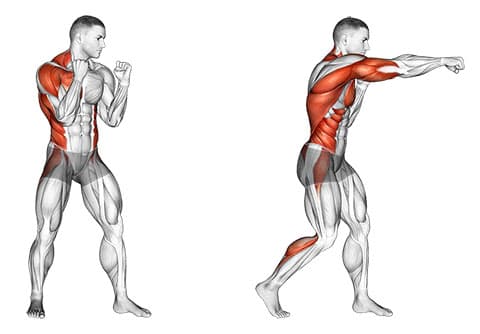
Brisk walking
Best for: Very low-impact base conditioning.
Key difference: Lower joint stress and easier pacing control.
Difficulty: Easy.
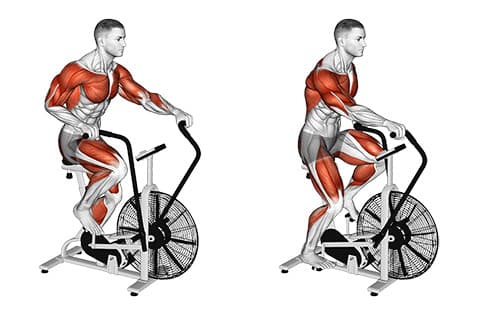
Machine air bike
Best for: Full-body cardio with simple intensity control.
Key difference: Adds upper-body push-pull involvement with machine support.
Difficulty: Moderate. See machine air bike.
Cycling or spin bike
Best for: Lower-impact conditioning with repeatable output.
Key difference: Seated mechanics reduce impact compared with dance or jog formats.
Difficulty: Easy to moderate.
What Equipment Do You Need for Aerobics?
Supportive shoes and enough floor space are the main requirements. Optional tools include a step platform, heart-rate monitor, and timer for interval work.
Frequently Asked Questions
Build your plan with Momentum.
Get structured workouts based on your goals, equipment, and training history.