Boxing Workout: How to Shadowbox With Good Form
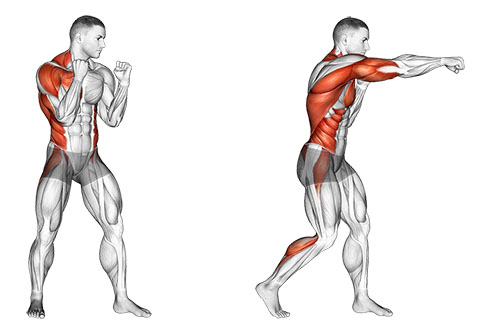
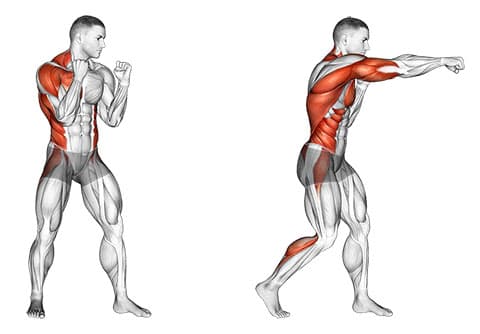
To do boxing as a workout (shadowboxing), get into an athletic stance with hands up, then throw crisp punches in short combinations while you move your feet and return to guard. Work in timed rounds with rest. It’s a practical way to build cardio and coordination when you don’t have equipment.
What Muscles Does Boxing Work?
Boxing as exercise is mostly a conditioning challenge, but it also trains the legs and hips to drive movement, the core to transfer force, and the shoulders and arms to repeatedly punch and return to guard. The better your footwork and trunk control, the more “whole body” it feels.
| Role | Muscles | Function |
|---|---|---|
| Primary system | Cardiovascular system | Supports repeated rounds and recovery between bursts. |
| Power + movement | Glutes, quads, calves | Push the floor for punches, pivots, and quick steps. |
| Transfer + stability | Obliques, deep core | Rotate and brace so punches stay balanced and snappy. |
| Punch endurance | Delts, triceps, forearms | Repeatedly extend the arm, stabilize the wrist, and return to guard. |
How Do You Perform Boxing?
Stand in a balanced stance with hands up, throw clean punches that start from the floor and snap back to guard, and keep your feet moving with small steps and pivots; work in short rounds so technique stays sharp.
- Stance: One foot slightly back, knees soft, weight centered, chin tucked.
- Guard: Hands up by cheekbones, elbows in, shoulders relaxed.
- Jab: Quick straight punch with the lead hand; snap it back to guard.
- Cross: Rotate the hips and rear shoulder through, then return to stance.
- Add one combo: Start with
jab–cross, thenjab–cross–hookonce you stay balanced. - Move your feet: Small steps forward/back/side, staying in stance—don’t cross your feet.
- Breathe: Short exhales on punches; avoid holding your breath during combinations.
- Round structure: Work 30–90 seconds, rest 30–60 seconds, and repeat.
What you should feel: legs and core doing most of the “work,” with the hands snapping out and back. Keep wrists straight on impact and relax your shoulders between combinations.
What Are the Benefits of Boxing?
Shadowboxing builds conditioning and coordination because you’re combining footwork, trunk rotation, and repeated punches under fatigue.
- Cardio with skill: You get heart-rate work while practicing movement quality.
- Full-body rhythm: Legs and hips set the timing; the core connects it; the hands finish it.
- Low equipment barrier: You can train anywhere with enough space and a timer.
- Easy intensity control: You can make it lighter by slowing down or harder by extending rounds and shortening rest.
What Are Common Boxing Mistakes?
The #1 mistake is punching only with the arms while the feet and hips stay dead.
Are you “arm punching” with no hip rotation?
Problem: Punches look slow and your shoulders burn fast.
Why it happens: You’re not pushing the floor or turning the hips.
Fix: Let the rear heel pivot and feel the hips start the cross.
Are your hands dropping between punches?
Problem: Guard disappears and the shoulders shrug up.
Why it happens: Fatigue and lack of habit.
Fix: Punch “out and back” to the same guard position every time.
Are you holding your breath during combos?
Problem: You gas out early and lose rhythm.
Why it happens: Tension spikes under effort.
Fix: Short, sharp exhales on each punch and relaxed inhales on resets.
Are your feet crossing or getting stuck?
Problem: You lose balance when you try to move.
Why it happens: Steps are too big or you’re standing too narrow.
Fix: Take smaller steps, keep feet shoulder-ish width, and stay in stance.
Is Boxing Good for Beginners?
Yes. Start with slow shadowboxing and just two punches (jab–cross) until your stance and balance feel automatic. Keep wrists straight, punches short, and rounds brief so you don’t learn sloppy habits.
How Hard Should Your Shadowboxing Rounds Be?
Think of intensity as speed + tension + round length, not weight.
Simple round templates:
| Level | Work | Rest | Notes |
|---|---|---|---|
| Beginner | 6–10 × 30 sec | 30–45 sec | Crisp jab–cross, focus on guard. |
| Intermediate | 5–8 × 60 sec | 30–60 sec | Add one new combo and footwork. |
| Hard conditioning | 6–10 × 90 sec | 30 sec | Keep technique clean; back off if form breaks. |
A good cue: you should be breathing hard, but you should still be able to snap punches back to guard without your shoulders creeping up to your ears.
How Often Should You Do Boxing?
Shadowboxing fits well 2–5 days per week, depending on how hard you push the rounds and what else you’re training.
- As cardio: 10–20 minutes total rounds, 2–4x/week.
- As a warm-up: 3–6 short rounds before strength training.
If your wrists or shoulders get cranky, shorten rounds and clean up punch mechanics before you add volume.
How Does Boxing Compare to Kickboxing?
Boxing focuses on punches, head movement, and footwork, while kickboxing adds kicks and knees, which changes stance, distance, and fatigue (especially in the hips).
| Style | What you’ll practice most | What tends to fatigue first |
|---|---|---|
| Boxing / shadowboxing | Jab–cross rhythm, pivots, guard discipline | Shoulders and calves. |
| Kickboxing | Kicks, stance changes, hip turnover | Hips and core (plus balance). |
What Are the Best Alternatives to Boxing?
If you want a similar conditioning hit but with a different movement feel, try one of these.
Alternative Exercises
Jump rope
Best for: Simple, equipment-light conditioning with foot rhythm.
Key difference: No punching; more calf/ankle demand.
Difficulty: Medium.
High knees (intervals)
Best for: Quick cardio bursts with no equipment.
Key difference: More impact and hip flexor fatigue.
Difficulty: Easy → medium.
Rowing machine
Best for: Hard conditioning with less joint impact.
Key difference: Pulling endurance instead of striking coordination.
Difficulty: Medium.
Heavy bag work
Best for: More resistance and feedback on punches.
Key difference: Requires bag, wraps/gloves, and good wrist alignment.
Difficulty: Medium → hard.
What Equipment Do You Need?
You don’t need equipment to shadowbox, but a few things can make it easier on your joints.
- Required: Open space and a timer.
- Helpful: Supportive shoes (or a grippy floor), a mirror to check guard and stance.
- If you hit a bag: Wraps and gloves help protect wrists and knuckles; start light and keep the wrist straight.
Frequently Asked Questions
Build your plan with Momentum.
Get structured workouts based on your goals, equipment, and training history.