How to Do Machine Air Bike
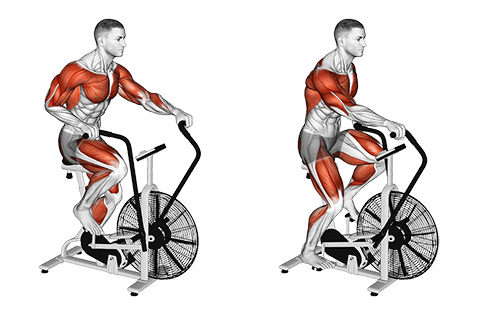
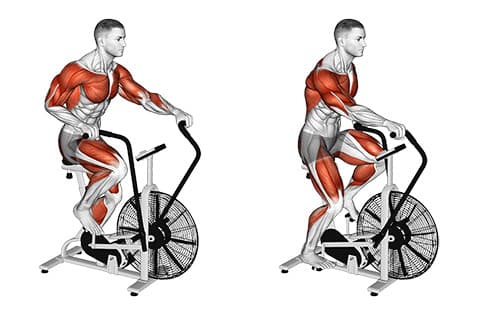
To do machine air bike correctly, set your seat height first, then pedal and push-pull the handles in a steady rhythm you can sustain for the full interval. The movement trains full-body conditioning with low impact. It is effective for warm-ups, steady cardio, or hard interval finishers.
What Does Machine Air Bike Train?
Machine air bike work is primarily cardiovascular, but it also loads major upper- and lower-body muscle groups every stroke. Legs create most of the drive while arms and trunk contribute to total output and stability.
| Role | Muscles/System | Function on Air Bike |
|---|---|---|
| Primary | Cardiovascular system | Supports continuous energy demand during intervals or steady work |
| Secondary | Quadriceps, glutes, hamstrings, calves | Produce pedal force through each cycle |
| Secondary | Front delts, triceps, lats | Drive and recover handle push-pull movement |
| Stabilizers | Abdominals, lower back | Keep torso position stable while fatigue rises |
How Do You Use a Machine Air Bike?
Dial in seat setup and posture first, then match effort to your target interval so output stays controlled and repeatable.
- Adjust the seat so your knee has a slight bend at the bottom of the pedal stroke.
- Place hands on moving handles with neutral wrists and a relaxed grip.
- Sit tall with ribs stacked over hips, then begin pedaling at an easy pace.
- Coordinate leg drive with handle push-pull so both upper and lower body contribute.
- Breathe rhythmically and keep cadence smooth instead of jerky sprint surges.
- During hard intervals, build effort over the first few seconds rather than exploding immediately.
- Recover by easing cadence gradually before stopping.
What Are the Benefits of Machine Air Bike?
The machine air bike gives high conditioning return with simple setup and low impact.
- Full-body cardio stimulus: Arms and legs work together, raising total output potential.
- Scalable intensity: Resistance increases naturally as you pedal harder.
- Joint-friendly conditioning: Seated, cyclical mechanics reduce impact compared with running.
- Useful for mixed training blocks: Works for warm-ups, aerobic base, and anaerobic intervals.
Common Machine Air Bike Mistakes and Fixes
The most common mistake is going all-out too early and losing output quality after the first round.
Why do I fade hard after one or two intervals?
Problem: Pacing is front-loaded.
Why it happens: Starting at max effort instead of target effort.
Fix: Use a repeatable pace you can hold across all rounds, then increase gradually.
Why do my knees feel awkward on the bike?
Problem: Seat height or fore-aft position is off.
Why it happens: Setup is skipped before work begins.
Fix: Adjust seat so knee is slightly bent at bottom and hips stay level.
Why do my shoulders and neck tighten up?
Problem: Excess upper-body tension reduces efficiency.
Why it happens: Death grip on handles and shrugged shoulders.
Fix: Relax grip pressure and keep shoulders down while breathing regularly.
Why does my output bounce up and down each round?
Problem: Cadence is inconsistent and technique breaks under fatigue.
Why it happens: No pacing target or interval structure.
Fix: Track watts or calories per minute and stay within a small target range.
Is Machine Air Bike Good for Beginners?
Yes. Beginners can start with short, moderate intervals and focus on smooth rhythm before hard efforts. A simple entry point is 8 to 12 rounds of 20 seconds easy-moderate work with 40 to 60 seconds easy recovery.
How Should You Program Machine Air Bike Intervals?
Air bikes do not use plate loading. Progress by controlling pace, interval length, and work-to-rest ratio.
| Goal | Work Interval | Rest Interval | Target Effort |
|---|---|---|---|
| Aerobic base | 2 to 5 min | 1 to 2 min easy spin | RPE 5 to 6 |
| Mixed conditioning | 30 to 60 sec | 60 to 120 sec | RPE 7 to 8 |
| Sprint power | 10 to 20 sec | 90 to 150 sec | RPE 9 to 10 |
For 4 weeks, increase total hard-work minutes first, then reduce rest or raise interval effort.
Evidence comparing interval and continuous aerobic training shows both methods improve cardiorespiratory fitness, with interval structures sometimes driving larger VO2max gains when dosing and recovery are appropriate (Viana et al.).
Output Consistency Target
Aim to keep interval output within about 5% to 10% from your first to last work round. If drop-off is bigger, lower starting pace so quality stays repeatable.
How Often Should You Use a Machine Air Bike?
Use air bike 2 to 4 times weekly based on total training stress. Pair hard intervals with easier days between them, and use steady sessions on days when lifting volume is high. A useful weekly anchor is 150 to 300 minutes of moderate aerobic work (or 75 to 150 vigorous), then adjusting interval dose around recovery and lifting demands (WHO, U.S. Physical Activity Guidelines).
How Does Machine Air Bike Compare to a Rower?
Both are low-impact conditioning tools, but air bike intervals usually ramp intensity faster because resistance increases instantly with effort. For body-composition outcomes, method choice is often less important than consistency, because meta-analytic results show HIIT and moderate-intensity continuous approaches can produce similar effects in some populations (Batrakoulis et al.).
| Machine | Best for | Main Limiter |
|---|---|---|
| Air bike | Repeatable high-intensity intervals | Breathing and local leg burn |
| Rower | Rhythm-based full-body endurance | Technique timing and posterior-chain fatigue |
What Are the Best Alternatives to Machine Air Bike?
The best alternatives deliver similar cardio benefits with different skill or equipment needs.
Alternative Exercises
Rowing machine
Best for: Low-impact intervals with strong posterior-chain involvement.
Key difference: Pull-dominant pattern with technical stroke sequencing.
Difficulty: Moderate.
Spin bike intervals
Best for: Lower-body focused conditioning with easy pacing control.
Key difference: No moving handles, less upper-body contribution.
Difficulty: Easy to moderate.
Aerobics circuits
Best for: No-machine conditioning at home or in classes.
Key difference: Uses bodyweight movement patterns instead of seated cycling.
Difficulty: Easy to moderate. See aerobics.
What Equipment Do You Need for Machine Air Bike?
You need an air bike with working display metrics (time, calories, or watts). A timer and notebook are useful for tracking repeatable interval outputs.
Frequently Asked Questions
Build your plan with Momentum.
Get structured workouts based on your goals, equipment, and training history.