How to Do Ab Wheel Rollouts
To do an ab wheel rollout, kneel with the wheel under your shoulders, brace your core, and roll forward only as far as you can keep your lower back neutral. The move heavily trains anti-extension core strength and full-body tension. It is excellent for lifters who want stronger bracing for presses, squats, and pulls.
What Muscles Does Ab Wheel Rollout Train?
Ab wheel rollouts primarily challenge the abdominals, especially when resisting spinal extension at long lever lengths. Lats, front delts, and triceps help control the wheel path while glutes and lower back assist with total-body stability. EMG analysis of rollout-style core work has shown high trunk-muscle activation when technique stays strict (Escamilla et al.).
| Role | Muscles | Function in Ab Wheel Rollout |
|---|---|---|
| Primary | Abdominals | Resist lumbar extension as torso lengthens |
| Secondary | Lats, front delts, triceps | Guide the wheel path and support shoulder position |
| Stabilizers | Glutes, lower back | Keep pelvis from tipping and torso from collapsing |
How Do You Perform Ab Wheel?
Set a strong brace before each rep, then roll forward with control and stop at the deepest position where you can still hold a neutral spine.
- Kneel on a mat with the wheel directly below your shoulders and your hands gripping both handles evenly.
- Tuck your pelvis slightly, squeeze glutes, and exhale to set your ribcage over your hips.
- Roll the wheel forward slowly while keeping hips and shoulders moving together, not dropping your hips first.
- Stop when you feel your lower back start to arch or your ribs flare up, even if range is short.
- Pull the wheel back by driving hands down and engaging abs and lats, returning to the start without jerking.
- Reset your breath and brace before starting the next rep.
What Are the Benefits of Ab Wheel?
Ab wheel rollouts develop high-tension core strength that transfers to heavier compound lifting and athletic movement.
- Strong anti-extension capacity: You learn to resist lumbar arching under long-lever stress.
- Efficient full-body integration: Lats, shoulders, trunk, and hips coordinate through one pattern.
- Clear progression path: Range, tempo, and starting position make difficulty easy to scale.
- Low equipment demand: One wheel and a mat can create a challenging core session.
Common Ab Wheel Rollout Mistakes and Fixes
The biggest error is rolling farther than you can control and letting the lower back take over.
Why does my lower back pinch during rollouts?
Problem: Lumbar spine extends at end range.
Why it happens: You chase depth before owning trunk tension.
Fix: Shorten rollout distance, add a slight posterior pelvic tilt, and progress range gradually.
Why do my hips drop before my arms move?
Problem: You lose body-line control and turn the rep into a back bend.
Why it happens: Weak brace and poor sequencing.
Fix: Think ribs down and glutes on before every rep; move shoulders and hips together.
Why do my shoulders shrug up around my ears?
Problem: Upper traps dominate and shoulder mechanics get sloppy.
Why it happens: Excess tension in neck and narrow grip pressure.
Fix: Keep neck long, lightly depress shoulders, and grip firmly without over-squeezing.
Why can’t I pull the wheel back smoothly?
Problem: Return phase turns into momentum or a hard yank.
Why it happens: Going too deep for your current strength.
Fix: Reduce depth and use slower eccentrics until control improves.
Is Ab Wheel Rollout Good for Beginners?
Ab wheel can work for beginners, but only with a controlled regression. Start with short-range kneeling reps and stop before spinal position changes. If you cannot hold a neutral trunk, build a base with planks or ab scissors first.
How Do You Progress Ab Wheel Rollouts?
Ab wheel difficulty comes from leverage, not external weight. Progress by increasing rollout distance, improving tempo, and reducing assistance. This follows standard resistance-training progression guidance: raise demand gradually while preserving rep quality (ACSM position stand).
| Week | Prescription | Progression Target |
|---|---|---|
| 1 | 3 sets of 5 to 6 kneeling reps | Stop at first loss of trunk position |
| 2 | 3 sets of 6 to 8 kneeling reps | Add 1 to 2 controlled reps per set |
| 3 | 3 sets of 5 to 6 reps with slower 3-second rollout | Improve eccentric control |
| 4 | 3 to 4 sets of 6 to 8 deeper reps | Increase range while keeping neutral spine |
If form breaks, keep current week until reps are clean. Meta-analytic evidence suggests training to absolute failure is not required for hypertrophy, so stop sets when spinal control degrades instead of grinding poor reps (Grgic et al., Refalo et al.).
Readiness Gates for Harder Rollout Variations
Before increasing range or attempting standing progressions, confirm all three:
- You can complete all prescribed reps without lumbar extension.
- You can pause for 1 second near end range and still keep ribs down.
- Your return phase is controlled, not a momentum pull back.
How Often Should You Train Ab Wheel Rollouts?
Use ab wheel 2 to 3 times weekly, usually after major lifts or at the end of upper-body sessions. Rest at least 48 hours between hard rollout sessions so trunk and shoulder stabilizers can recover.
How Does Ab Wheel Compare to Stability Ball Rollouts?
Both train anti-extension core strength, but ab wheel rollouts usually create a steeper difficulty curve because the base of support is smaller and the lever can lengthen farther.
| Exercise | Best for | Difficulty |
|---|---|---|
| Ab wheel rollout | Advanced core tension and carryover to lifting | Moderate to high |
| Stability ball rollout | Learning rollout mechanics with more forgiveness | Low to moderate |
What Are the Best Alternatives to Ab Wheel?
The best alternatives keep anti-extension demands but adjust stability and loading to match your current level.
Alternative Exercises


-(female)_small.jpg&w=3840&q=75)

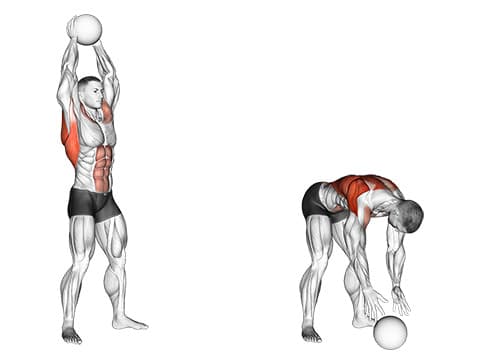
Stability ball rollout
Best for: Beginners learning rollout mechanics.
Key difference: Larger, more stable contact point lowers balance demand.
Difficulty: Low to moderate.
Body saw plank
Best for: Building anti-extension strength without wheel grip demands.
Key difference: Forearm plank base with controlled forward-back glide.
Difficulty: Moderate.
Barbell rollout
Best for: Lifters training in a barbell-only setup.
Key difference: Uses loaded bar with plates as rolling surface.
Difficulty: Moderate to high.
What Equipment Do You Need for Ab Wheel Rollouts?
You need an ab wheel and a mat for your knees. A wall marker, box, or tape line can help you standardize rollout depth from week to week.
Frequently Asked Questions
Build your plan with Momentum.
Get structured workouts based on your goals, equipment, and training history.