How to Do the Suspension Bicep Curl (Form, Muscles Worked, Mistakes)
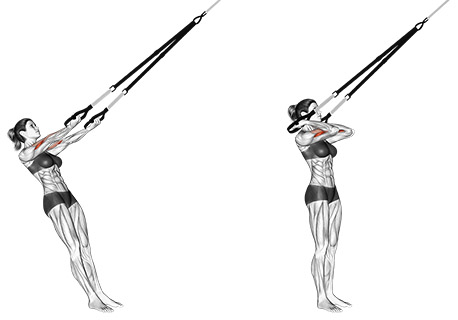
To do the suspension bicep curl, lean back on straps with a stiff body, curl your hands toward your temples, then extend slowly back out. It mainly trains your biceps while your core keeps you in a plank.
What Muscles Does Suspension Bicep Curl Work?
Suspension bicep curls primarily train the biceps, with the brachialis and forearms assisting to flex the elbow while your core, lats, and upper back help keep your body rigid and your shoulders stable.
| Muscle group | Role | What it does in this lift |
|---|---|---|
| Biceps (biceps brachii) | Primary | Flexes the elbow as you pull your hands toward your face. |
| Brachialis + brachioradialis | Secondary | Assists elbow flexion, especially as fatigue builds. |
| Forearm flexors | Stabilizer | Helps keep grip and wrist position stable on the handles. |
| Core (abs + glutes) | Stabilizer | Prevents hips from sagging and keeps the body in a plank. |
| Lats + upper back | Stabilizer | Helps keep shoulders “packed” as the straps pull you forward. |
How Do You Perform Suspension Bicep Curl?
Set the straps to mid-length, lean back with a straight body and palms up, curl your hands toward your forehead while keeping elbows high, then extend your arms slowly until you’re back in the starting lean without letting hips sag.
- Anchor + straps: Use a secure anchor point overhead and set the straps to about mid-length.
- Start position: Face the anchor, grab the handles with palms up, and walk your feet forward so your body leans back.
- Set your body: Squeeze glutes, brace abs, and keep a straight line from head to heels (like a standing plank).
- Elbows high: Bring elbows slightly forward and keep them high; don’t let them drop as you move.
- Curl: Curl your hands toward your temples/forehead by bending your elbows. Keep shoulders down and back.
- Lower: Extend your arms slowly back to the start, keeping tension and keeping hips from sagging.
- Make it harder: Walk feet farther forward or slow the lowering phase.
What Are the Benefits of Suspension Bicep Curl?
Suspension curls are a strong biceps builder you can scale without weights, and they also teach you to keep your whole body tight while your arms work.
- Home- and travel-friendly: No dumbbells required—just straps and an anchor point.
- Easy difficulty scaling: Small changes in body angle make a big difference.
- Core involvement: You get a built-in anti-extension plank while curling.
- Clean form feedback: If you lose tension, you’ll feel it immediately in hips and shoulders.
What Are Common Suspension Bicep Curl Mistakes?
The most common suspension curl mistake is letting your hips sag, which turns the rep into a loose, shoulder-y pull instead of a strict curl.
Are your hips sagging or ribs flaring?
Problem: You lose the straight line from head to heels and the rep feels unstable.
Why it happens: You’re too far under the anchor (too hard) or not bracing.
Fix: Walk feet back a step, squeeze glutes, and think “ribs down” the whole set.
Are your elbows dropping?
Problem: It turns into more of a row than a curl, and biceps tension drops.
Why it happens: You’re letting the shoulder drift and searching for leverage.
Fix: Keep elbows high and slightly in front of your torso; curl hands toward your temples, not your chest.
Are you shrugging at the top?
Problem: Upper traps take over and shoulders feel cranky.
Why it happens: You’re chasing range by lifting the shoulders.
Fix: Keep shoulders down and back; stop when you can’t curl farther without shrugging.
Are you rushing the lowering phase?
Problem: The straps “snap” you back and you miss the stretch.
Why it happens: Fatigue or trying to go too hard too soon.
Fix: Use a 2–4 second lower and keep tension the entire time.
Is Suspension Bicep Curl Good for Beginners?
Yes, if you choose an easy angle. Start more upright (feet farther back) so you can keep hips tight and shoulders down. Once you can do clean sets, walk your feet forward gradually to increase difficulty.
How Do You Progress Suspension Bicep Curl?
Because this is bodyweight-based, you progress by changing leverage and tempo instead of adding plates.
| Progression lever | How to do it | What it changes |
|---|---|---|
| Body angle | Walk feet forward (more lean) | Increases load on the biceps and core. |
| Tempo | 3–5 sec lowering + 1 sec squeeze | More time under tension without changing angle. |
| Range of motion | Start with arms fully straight (no slack) | Bigger stretch and harder bottom portion. |
| Single-arm work | One arm at a time (advanced) | Much harder; keep the body rigid. |
Simple progression: keep the same strap length, add reps until you’re near the top of your range, then take one small step forward and build reps again.
How Often Should You Do Suspension Bicep Curl?
Suspension curls work well 2–4 times per week. Treat them like any other curl: pick a variation difficulty that lets you stay strict, and aim for a rep range you can progress (often 6–15 reps per set).
How Does Suspension Bicep Curl Compare to Dumbbell Bicep Curl?
Suspension curls let you scale difficulty with body angle and add a core challenge, while dumbbells are easier to load precisely and track with exact weights.
| Option | Best for | Tradeoff |
|---|---|---|
| Suspension bicep curl | Home training, adjustable difficulty, core engagement | Requires straps + a safe anchor and some setup practice. |
| Dumbbell bicep curl | Precise loading and unilateral balance | Easier to cheat with torso swing when fatigued. |
What Are the Best Alternatives to Suspension Bicep Curl?
If you don’t have straps (or want more precise loading), dumbbells, cables, barbells, and machines all work well for direct biceps training.
Alternative Exercises


Dumbbell bicep curl
Best for: Precise loading and training one arm at a time.
Key difference: You can supinate as you curl and choose a wrist angle that feels good.
Difficulty: Easy to progress with small jumps.
Cable bicep curl
Best for: Constant tension and cleaner reps.
Key difference: The cable stays loaded through more of the range.
Difficulty: Great for higher reps and controlled tempo.
Machine bicep curl
Best for: Strict reps when you’re fatigued.
Key difference: Guided path reduces cheating.
Difficulty: Very consistent rep-to-rep.
What Equipment Do You Need?
- Suspension trainer (or rings): TRX-style straps, gymnastic rings, or any stable suspension handles.
- Secure anchor point: A rack, a sturdy beam, or a door anchor designed for suspension training.
- Optional: grippy shoes or a mat: Helps you keep footing if your floor is slick.
A Simple Rep Range That Works Well
- Build strength/control: 3–5 sets of 6–10 reps (hard angle, slow lower).
- Build size: 2–4 sets of 8–15 reps (moderate angle, full range).
- Finish with a pump: 1–3 sets of 12–20 reps (easy angle, constant tension).
Frequently Asked Questions
Build your plan with Momentum.
Get structured workouts based on your goals, equipment, and training history.