How to Do the Kneeling Cable Crunch
To do a kneeling cable crunch, kneel under a high pulley with a rope behind your head and curl your ribs toward your pelvis while keeping your hips mostly still. This movement mainly trains the abdominals through loaded spinal flexion. It’s a straightforward way to overload your abs without needing advanced bodyweight progressions.
What Muscles Do Kneeling Cable Crunches Work?
Kneeling cable crunches primarily work the abdominals by flexing the spine against the cable. Hip flexors can contribute if you hinge a lot at the hips, but the best reps feel like your abs are doing the curling.
| Role | Muscles | What they do here |
|---|---|---|
| Primary | Abdominals | Curl ribs toward pelvis and control the return |
| Secondary | Hip flexors | Assist if the movement turns into a hip hinge |
| Stabilizers | Lats, shoulders | Keep the rope position steady while you move your torso |
How Do You Perform a Kneeling Cable Crunch?
Set the pulley high, kneel, and crunch by moving your ribcage down toward your pelvis—don’t just fold at the hips.
- Set the cable pulley high and attach a rope. Grab it with both hands and bring your hands beside your ears.
- Kneel a step back from the stack with a slight forward lean so the cable stays tensioned.
- Exhale to bring ribs down, then brace your abs. Keep your hips mostly in place.
- Crunch by curling your torso down (ribs toward pelvis). Keep elbows in and avoid pulling the rope with your arms.
- Pause for 1 second at the bottom, then return slowly until your abs lengthen—no stack slams.
What Are the Benefits of the Kneeling Cable Crunch?
Cable crunches let you train the abs hard with a simple movement and predictable progression.
- Easy overload: Add small amounts of weight over time while keeping form consistent.
- Direct ab stimulus: The rope setup makes it easier to feel the abs shorten and lengthen.
- Time-efficient: High-rep sets deliver a lot of work without learning a complex skill.
- Scales to many levels: Range of motion, tempo, and load all adjust difficulty quickly.
What Are Common Cable Crunch Mistakes?
The biggest mistake is using too much weight and turning the crunch into a swinging hip hinge.
Why do I feel cable crunches mostly in my hips?
Problem: Your hips fold a lot and your torso barely curls.
Why it happens: Load is too heavy or you’re trying to “touch elbows to knees.”
Fix: Lower the weight, keep hips stacked over knees, and think “ribs to pelvis.”
Why does my neck get sore?
Problem: You pull your head down with your arms.
Why it happens: The rope drifts forward and you start yanking.
Fix: Keep hands beside your ears, keep your chin gently tucked, and move your torso—not your hands.
Why am I bouncing at the bottom?
Problem: You slam into the bottom and rebound into the next rep.
Why it happens: Too much load and a rushed eccentric.
Fix: Use a weight you can pause with and control for 12 to 20 reps.
Why does my lower back feel irritated?
Problem: You collapse into end-range flexion or lose control on the return.
Why it happens: Too much range, too much load, or both.
Fix: Shorten the range, slow the tempo, and stop if pain persists—choose an anti-extension core move instead.
Are Kneeling Cable Crunches Good for Beginners?
Yes—if you start light and focus on feeling the abs curl. If kneeling is uncomfortable, use a pad and keep the range short at first. If you can’t stop yourself from hinging, practice a slower tempo and pauses before you add weight.
How Much Weight Should You Use for Cable Crunches?
Pick a load that lets you keep tension and control the bottom position. A good checkpoint: you should be able to pause for 1 second at the bottom and still return smoothly.
Most people get better results using 12 to 20 clean reps before chasing heavier weight. The abs respond well to quality volume, and cable crunches punish momentum.
| Goal | Sets × reps | Rest | How hard should it feel? |
|---|---|---|---|
| Hypertrophy | 2 to 4 × 12 to 20 | 45–75 sec | Stop with 1–3 reps in reserve |
| Controlled strength | 3 to 4 × 8 to 12 | 60–90 sec | Pause every rep; no swinging |
How Often Should You Do Cable Crunches?
1 to 3 times per week is plenty for most lifters, usually toward the end of a workout. For a balanced core setup, pair crunches with an anti-rotation drill like the Pallof press and an anti-extension move like the ab wheel rollout.
What Are the Best Alternatives to Cable Crunches?
If cable crunches bother your back or you just want variety, rotate in options that train the core without the exact same spinal motion.
Alternative Exercises


-(female)_small.jpg&w=3840&q=75)

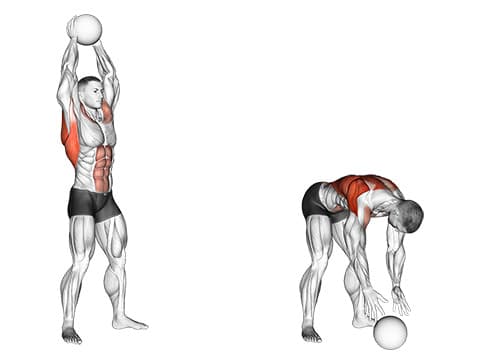
Reverse crunch
Best for: People who feel crunches more in hip flexors than abs.
Key difference: Pelvis moves toward ribs instead of ribs toward pelvis.
Difficulty: Low to moderate.
Pallof press
Best for: Training core stability without repeated spinal flexion.
Key difference: You resist twisting instead of crunching.
Difficulty: Low to moderate.
Ab wheel rollout
Best for: Anti-extension strength and bracing.
Key difference: You resist arching instead of flexing.
Difficulty: Moderate to high.
What Equipment Do You Need?
You need a cable station with a high pulley and a rope attachment. A kneeling pad is a nice upgrade if you train on hard floors.
Frequently Asked Questions
Build your plan with Momentum.
Get structured workouts based on your goals, equipment, and training history.